
The global agricultural sector stands at the center of an unprecedented triple crisis: the progressive biological degradation of arable soils, the surge in synthetic chemical fertilizer costs driven by geopolitical volatility in natural gas and phosphate, and the increasing intensity of prolonged droughts caused by climate change.
The conventional agro-industrial model — based on intensive deep plowing, monocultures, and massive applications of synthetic NPK (Nitrogen, Phosphorus, Potassium) inputs — has led to the loss of over 50% of soil organic matter in agricultural lands across Southern Europe and the Mediterranean basin over the last fifty years.
In this scenario, Regenerative Agriculture is no longer merely an ethical choice, but an economic and industrial imperative. Among next-generation biotechnological and agronomic solutions, integrating biochar into agricultural soils is emerging as the most effective intervention to restore physical soil structure, maximize water retention, and halve reliance on synthetic fertilizers while simultaneously enhancing crop yields.
1. Soil Organic Matter at Year Zero: Why a Stable Mineral-Organic Matrix Is Essential
Soil fertility is not measured solely by dissolved chemical elements, but above all by its aggregate structure and the presence of humified organic matter.
In conventional soil, synthetic nitrogen and phosphorus applied via chemical fertilizers are highly water-soluble. During heavy rainfall or overhead irrigation, up to 50–60% of nitrogen and phosphorus is lost through leaching before plant roots can absorb it. This phenomenon triggers two major issues:
- Direct Economic Damage: Farmers waste more than half of the costly fertilizers they purchase.
- Environmental Pollution: Leached nitrates and phosphates contaminate groundwater aquifers and cause eutrophication in rivers, lakes, and coastal marine basins.
[Traditional Chemical Fertilizer] ──(Rainfall/Irrigation)──> 60% Leached into Aquifers (Economic Loss)

[Fertilizer + Activated Biochar]  ──(Porous Matrix)────────> Nutrients Retained in Rhizosphere (Slow Release)
Biochar directly addresses this physical-chemical bottleneck. As a material composed of highly recalcitrant aromatic carbon, it does not degrade within a single growing season like green manure or raw compost; instead, it establishes a permanent mineral infrastructure within the soil profile.
2. Water Retention and Climate Resilience: The Physics of Micro-Porosity
The constant threat of crop water stress requires technologies capable of converting soil into a dynamic reservoir.
Biochar features a hierarchical molecular porosity consisting of micropores (< 2 nm), mesopores (2–50 nm), and macropores (> 50 nm). This three-dimensional matrix drastically alters soil physics:
┌────────────────────────────────────────────────────────────────────────┐
│                        MACRO-PORES (> 50 nm)                           │
│  Soil Aeration, Drainage of Excess Water, Root Space Exploration       │
├────────────────────────────────────────────────────────────────────────┤
│                        MESO-PORES (2 - 50 nm)                          │
│  Capillary Tension: Plant Available Water Capacity (AWC) Storage       │
├────────────────────────────────────────────────────────────────────────┤
│                        MICRO-PORES (< 2 nm)                            │
│  Habitat for Microorganisms & Protection from Microbial Predators     │
└────────────────────────────────────────────────────────────────────────┘
A. Increase in Water Holding Capacity (WHC)
Incorporating a controlled application rate of biochar (typically between 5 and 20 metric tons per hectare, depending on soil texture) increases the soil’s Water Holding Capacity (WHC) by up to 25–35%.
- In coarse sandy soils, biochar particles infill macro-structural voids, retaining moisture and preventing rapid evaporation.
- In dense clay soils, biochar reduces bulk density, improving root penetration and preventing root asphyxiation during heavy rain events.
B. Extended Irrigation Intervals
Thanks to greater moisture availability within the root zone (Available Water Capacity - AWC), crops grown in biochar-amended soils can withstand drought periods 14–21 days longer than unamended controls, cutting pumping energy demands and irrigation water volumes.
3. Biochar Inoculation and Activation: The “Charging” Technique
A common error in first-generation agronomy was applying “virgin” biochar (fresh from the reactor) directly to agricultural soils.
Raw biochar possesses a vast, unsaturated specific surface area; if applied uncharged, it temporarily adsorbs existing soil moisture and nutrients, inducing short-term crop nutrient deficits (nutrient immobilization).
To unlock biochar’s full agronomic potential, a Charging (Activation) process must be executed prior to soil application.
[Solid Virgin Biochar] + [Mature Compost / Digestate / Mycorrhizae] ──(3-4 Wk Co-Composting)──> [Bio-Activated Biochar]Professional Activation Methodologies:
- Co-Composting: Mix biochar (10–20% by volume) with fresh organic waste at the onset of composting. Biochar reduces ammonia emissions by 60%, retains nitrates, and becomes enriched with humic substances and thermophilic microorganisms.
- Anoxic Digestate Charging: Impregnate biochar with liquid digestate from biogas/biomethane plants. The biochar captures free ammoniacal nitrogen, converting a volatile liquid byproduct into a slow-release organo-mineral fertilizer (Slow-Release Fertilizer).
- Symbiont and Mycorrhizal Inoculation: Introduce PGPR (Plant Growth-Promoting Rhizobacteria) strains and mycorrhizal fungal spores (Glomus intraradices). Biochar’s porous architecture provides physical protection and nutrition for biological inoculants, fostering immediate root colonization.
4. Economic Impact and Agronomic Yields: Farm-Level ROI Calculation
Adopting biochar in regenerative agriculture is not a sunk operational expense, but an infrastructure investment in the land’s agronomic and real-estate value.
Field trial data across high-value crops (viticulture, olive orchards, fruit production, intensive horticulture, and arable crops) demonstrate clear financial returns:
| Agronomic Parameter | Conventional Practice | Regenerative Practice with Biochar | Efficiency Variance |
|---|---|---|---|
| NPK Fertilizer Consumption | 100% standard rate | 50 – 70% standard rate | 30–50% input savings |
| Irrigation Water Volume | 4,500 m³/ha / year | 3,200 m³/ha / year | ~28% water savings |
| Crop Yield Quantity | Baseline (100%) | 112% – 128% (5-year average) | +12% to +28% yield increase |
| Yield Stability in Drought | Severe contraction (-35%) | Contained reduction (-8%) | Extreme climate resilience |
| Carbon Credit Revenue | €0 / ha | €300 – €600 / ha / year | New farm revenue stream |
Integrated Return on Investment (ROI)
Considering biochar’s multi-decadal (and centennial) permanence in soil, initial purchase and application costs are typically recovered within 3 to 5 years through:
- Direct cost reductions in synthetic fertilizers and irrigation water.
- Higher unit margins on harvested agricultural produce (organic/regenerative certification).
- Revenues from CDR (Carbon Dioxide Removal) carbon credits generated by soil biochar application, tradeable on international registries via dMRV platforms.
5. The Mantohn SA Vision: Circular Agritech as a Strategic Asset
For Mantohn SA, integrating industrial pyrolysis of residual biomass with precision regenerative agriculture represents a core pillar of Europe’s sustainable industrial transition.
Our investment framework focuses on deploying Closed-Loop Agro-Industrial Hubs:
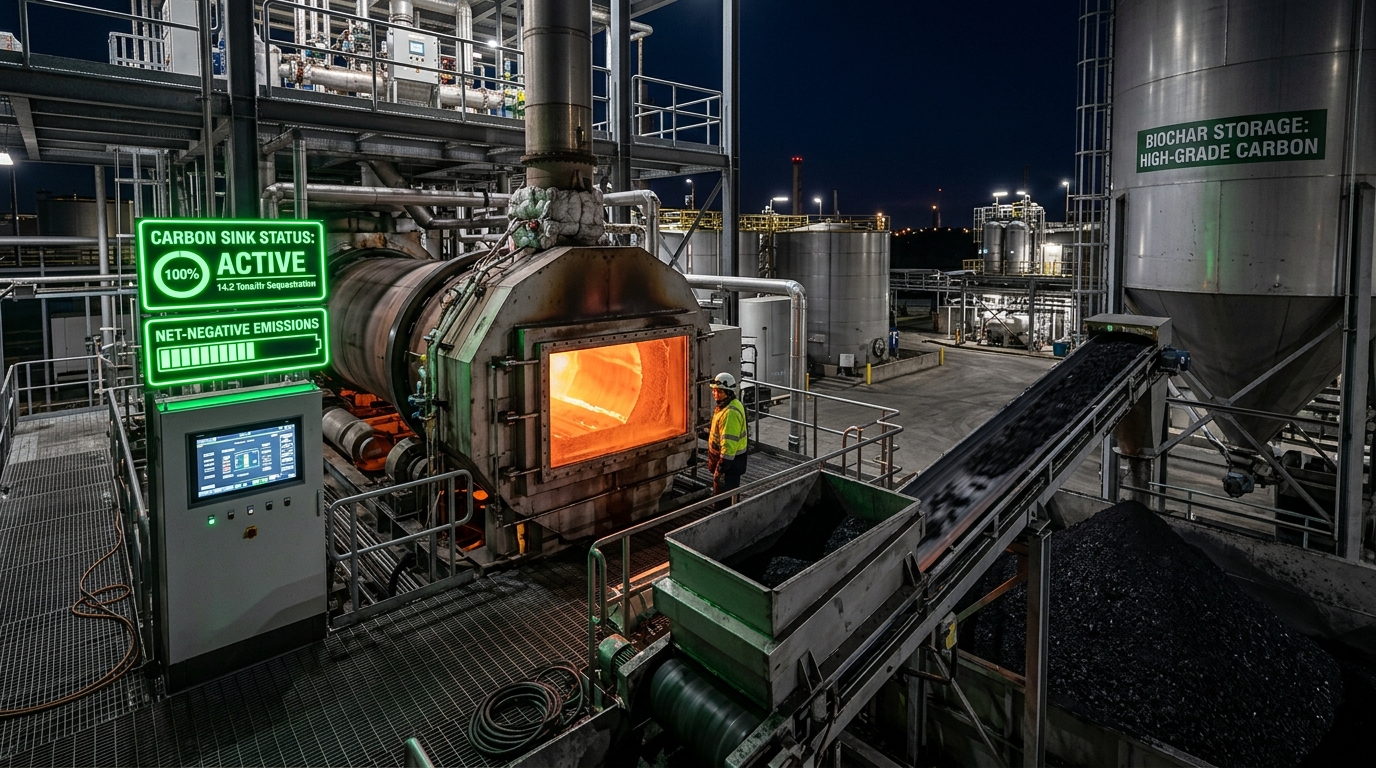
- Local Biomass Valorization: We convert agricultural prunings, vineyard trimmings, and non-merchantable forestry woodchips into EBC-certified quality biochar.
- Green Energy Cogeneration: Thermal energy recovered from pyrolysis reactors directly powers agricultural crop drying or high-efficiency greenhouse operations.
- Distribution & dMRV Certification: Bio-activated biochar is supplied to local farming enterprises paired with digital soil monitoring systems, securing yield gains and granting direct access to carbon credit monetization.
Investing in regenerative agritech safeguards food sovereignty, protects vital water resources, and appreciates land equity — transforming climate risk into long-term sustainable growth.