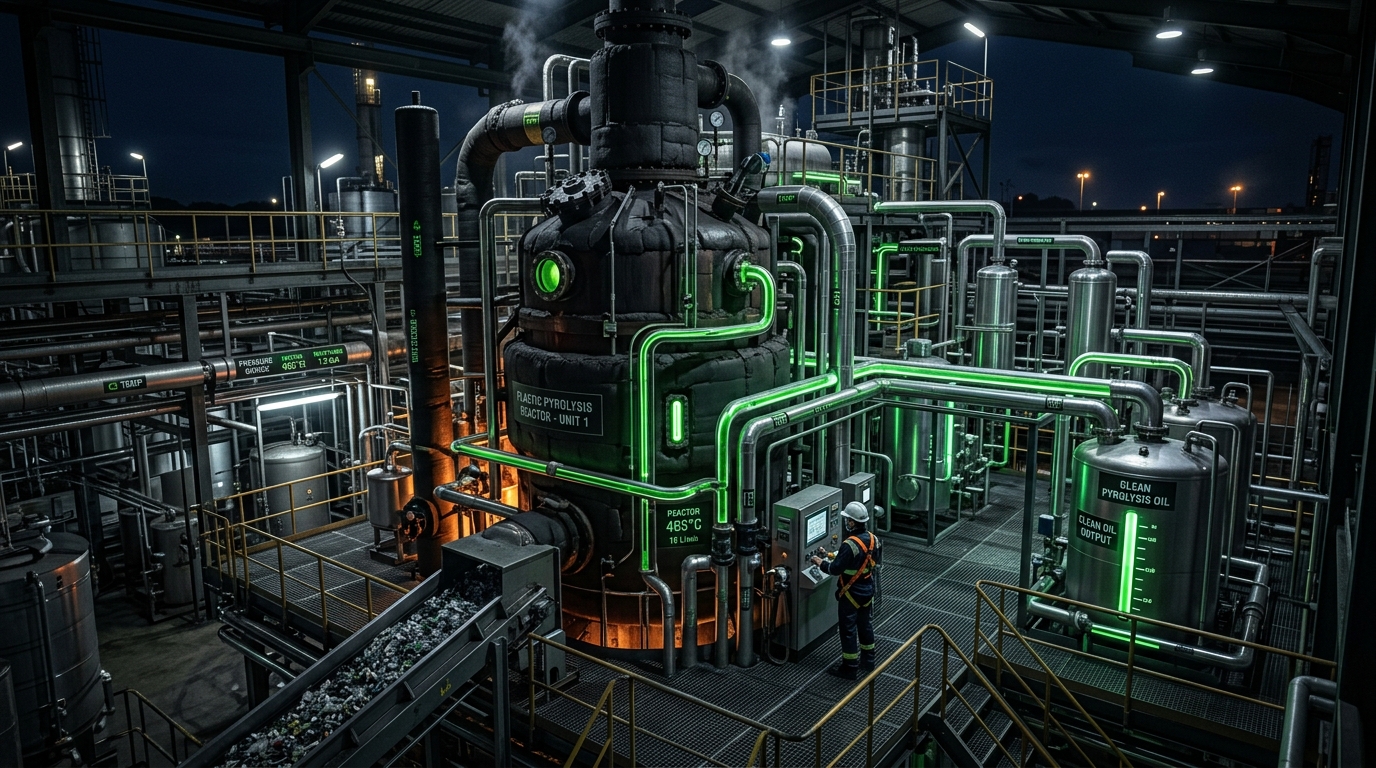
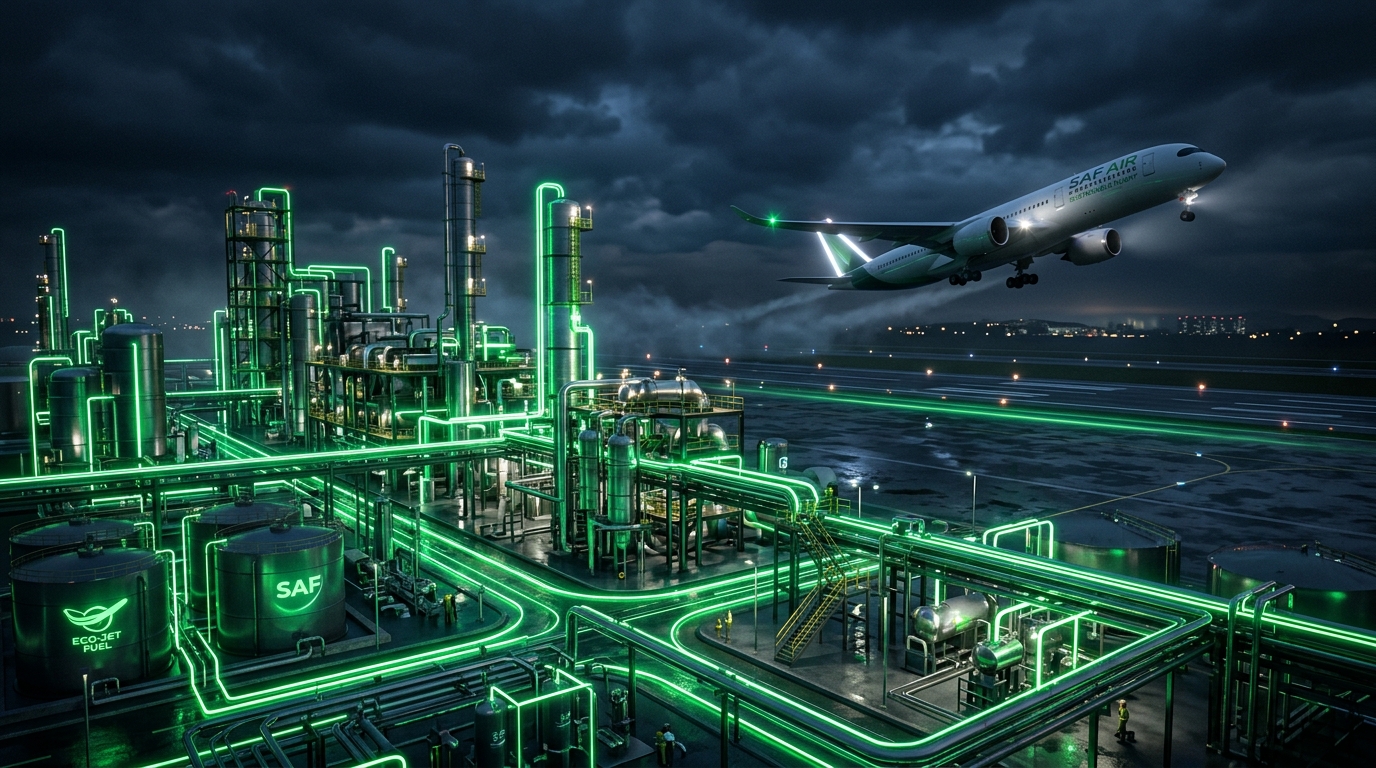
Commercial aviation accounts for approximately 2.5% of global carbon dioxide ($CO_2$) emissions and nearly 3.5% of total climate radiative forcing when accounting for high-altitude nitrogen oxides ($NO_x$), water vapor, and contrail formation. Unlike land transportation, light mobility, or industrial manufacturing, long-haul aviation belongs strictly to the hard-to-abate sector. The gravimetric energy density required by commercial jet aircraft (exceeding 42.8 MJ/kg) renders lithium-ion batteries and gaseous or liquid hydrogen propulsion systems technically unfeasible for transoceanic flights over the next three decades.
In this context of urgent industrial decarbonization, Sustainable Aviation Fuels (SAF) represent the only immediate, scalable, and drop-in compatible solution for existing airport fueling infrastructure and aircraft turbofan engines. With the enforcement of strict international mandates, such as the European Union’s RefuelEU Aviation directive — which mandates binding SAF blending quotas starting at 2% in 2025, rising to 6% in 2030, and reaching 70% by 2050 —, global sustainable kerosene demand must scale over fifty-fold within the coming decade.
While first-generation processes based on used cooking oils and animal fats (HEFA - Hydroprocessed Esters and Fatty Acids) are rapidly hitting absolute feedstock supply limits worldwide, lignocellulosic biomass gasification combined with Fischer-Tropsch synthesis (FT-SPK) emerges as the essential, strategic industrial pathway to unlock scalable, ethical, and high-impact production volumes.
1. From Biomass to Syngas: The Chemistry of High-Temperature Gasification
Gasification of lignocellulosic biomass is an advanced thermochemical process that converts low-density organic waste materials (such as forestry residues, non-commercial wood chips, agricultural byproducts, and non-recyclable municipal solid waste) into a highly purified synthesis gas (syngas), consisting primarily of carbon monoxide ($CO$) and hydrogen ($H_2$).
Unlike direct combustion, which releases thermal energy by completely burning organic matter in excess oxygen, gasification occurs under sub-stoichiometric oxygen conditions at elevated operating temperatures ($800^\circ\text{C}$ to $1400^\circ\text{C}$) and operating pressures up to 30 bar in advanced industrial gasifiers.
[Lignocellulosic Biomass] ──(Gasification Reactor: O2/Steam)──> [Raw Syngas: CO + H2 + CO2 + H2O + Tars]
                                                                        │
                                                             (Cleaning & Conditioning)
                                                                        │
                                                          [Purified Syngas: H2/CO Ratio = 2.0]
                                                                        │
                                                            (Fischer-Tropsch Synthesis)
                                                                        │
                                                             [SAF (FT-SPK) / Hydrocracking]
Reaction Thermodynamics and Chemistry
The thermochemical transformations inside bubbling fluidized bed (BFB), circulating fluidized bed (CFB), or entrained-flow gasifiers proceed through four sequential stages:
- Drying and Pyrolysis ($200^\circ\text{C} - 500^\circ\text{C}$): Complete removal of residual moisture and thermal decomposition of complex biopolymers (cellulose, hemicellulose, lignin) into volatile gases, heavy tars, and carbonaceous char.
- Partial Oxidation ($800^\circ\text{C} - 1200^\circ\text{C}$): Strongly exothermic reaction of solid carbon with introduced oxygen, providing heat for the overall process: $$C + \frac{1}{2}O_2 \rightarrow CO \quad (\Delta H = -110.5 \text{ kJ/mol})$$
- Char Gasification ($800^\circ\text{C} - 1000^\circ\text{C}$): Endothermic steam reaction converting solid carbon into synthesis gas: $$C + H_2O \rightarrow CO + H_2 \quad (\Delta H = +131.3 \text{ kJ/mol})$$
- Water-Gas Shift Reaction (WGSR): Reversible equilibrium adjusting gas proportions: $$CO + H_2O \rightleftharpoons CO_2 + H_2 \quad (\Delta H = -41.2 \text{ kJ/mol})$$
To supply downstream catalytic Fischer-Tropsch synthesis, the molar ratio of hydrogen to carbon monoxide ($H_2/CO$) must be precisely conditioned to a stoichiometric target of 2.0. This is accomplished by integrating a dedicated Water-Gas Shift reactor alongside an Acid Gas Removal (AGR) unit using chemical amine wash or physical refrigerated solvent systems (such as Rectisol).
2. Syngas Cleanup and Fischer-Tropsch Synthesis (FT-SPK)
A major technical challenge in biomass-to-liquid (BtL) plants is the presence of volatile contaminants in raw syngas. Unrefined syngas contains heavy tars, particulate fly ash, hydrogen sulfide ($H_2S$), carbonyl sulfide ($COS$), hydrogen chloride ($HCl$), and trace metal carbonyls. Fischer-Tropsch catalysts are exceptionally sensitive to sulfur poisoning and tar deposition, requiring contaminant levels in the feed gas to remain strictly below 1 ppmv (parts per million by volume).
Multi-Stage Gas Purification Architecture
To ensure multi-year catalyst longevity, the gas conditioning island features:
- Catalytic Tar Cracking: High-temperature reforming ($800-900^\circ\text{C}$) of heavy aromatic hydrocarbons into $CO$ and $H_2$ using nickel- or dolomite-based catalyst beds.
- Hot Gas Particulate Filtration: Rigid ceramic filter candles capturing fly ash and particulate matter.
- Deep Desulfurization: Regenerable zinc oxide ($ZnO$) guard beds and impregnated activated carbon vessels to capture trace sulfur compounds.
Catalytic Polymerization and Synthesis Reactor
Cleaned syngas enters the Fischer-Tropsch synthesis reactor (typically Slurry Phase Distillate or Tubular Fixed Bed configurations). Over alumina-supported Cobalt ($Co$) or structured Iron ($Fe$) catalysts, carbon monoxide undergoes chain-building hydrogenation:
$$n CO + (2n+1) H_2 \rightarrow C_n H_{2n+2} + n H_2O$$
The resulting product is a synthetic crude (Syncrude) dominated by heavy paraffinic waxes.
3. Hydroprocessing and ASTM D7566 Drop-in Certification
Raw synthetic wax cannot be directly introduced into jet engines. To refine Syncrude into certified Sustainable Aviation Fuel, the material undergoes downstream Hydroprocessing:
- Selective Hydrocracking: Heavy wax molecules ($C_{20+}$) are cracked under high hydrogen pressure over bifunctional zeolite-metal catalysts into middle distillates ($C_9 - C_{16}$), matching standard kerosene cuts.
- Hydroisomerization: Linear n-paraffins are rearranged into branched iso-paraffins. This step reduces the fuel’s freezing point below $-47^\circ\text{C}$, meeting essential safety parameters for extreme high-altitude and polar flight routes.
The refined fuel, designated FT-SPK (Fischer-Tropsch Synthetic Paraffinic Kerosene), contains zero sulfur, zero heavy aromatics, and zero toxic metals. It is approved for blending up to 50% by volume with conventional fossil Jet A-1 under the ASTM D7566 Annex A2 specification.
4. Techno-Economic Matrix of SAF Pathways
| Parameter / Technology | HEFA (Used Oils / Fats) | Gasification + FT (Biomass) | Alcohol-to-Jet (AtJ) | E-Fuels (Power-to-Liquid) |
|---|---|---|---|---|
| Primary Feedstock | UCO, Tallow, Crop Oils | Forestry Residues, Ag-Waste | Bio-Ethanol / Isobutanol | Captured CO2 + Green H2 |
| Feedstock Scalability | Limited (Global cap near) | Very High (Substantial) | Medium | Unlimited (Power bound) |
| GHG Reduction (LCA) | 70% – 85% | 85% – 95% | 60% – 75% | 90% – 99% |
| Plant CAPEX (€/ton/yr) | €1,200 – €1,800 | €3,500 – €5,000 | €2,200 – €3,000 | >€6,000 |
| Feedstock OPEX | High and volatile | Low and long-term contractable | Medium-High | Power cost dependent |
| Scalability Horizon | Saturated by 2030 | Dominant 2030–2050 | Selective deployment | Long-term (post-2035) |
| Technology Readiness (TRL) | TRL 9 (Commercialized) | TRL 7 – 8 (First-of-a-kind plants) | TRL 7 – 8 | TRL 5 – 6 (Pilot/Demo) |
5. Investment Outlook and Mantohn SA Strategy
For venture capital, private equity, and institutional infrastructure funds, biomass gasification coupled with Fischer-Tropsch synthesis offers an attractive risk-adjusted return profile. While initial plant CAPEX is higher than simpler technologies, the low cost and long-term price stability of lignocellulosic residues insulate operating margins (EBITDA) against raw material price shocks.
Strategic Value Drivers:
- Long-Term Off-Take Contracts: Bankable 10-to-15-year take-or-pay agreements with global commercial airlines seeking regulatory compliance.
- Low Carbon Intensity Credits: Biomass-to-liquid plants achieve low lifecycle Carbon Intensity (CI) scores ($<15 \text{ gCO}_2\text{e/MJ}$), qualifying for premium credit monetization.
- Green Hydrogen Hybridization (Bio-e-Fuels): Supplementing excess $CO_2$ by-product streams with green electrolytic hydrogen boosts overall carbon conversion efficiency to 80%, doubling SAF output per biomass ton.
Mantohn SA actively structures and invests in advanced gasification facilities to lead industrial aviation decarbonization.