The search for ultra-sustainable, high-performance materials to replace petroleum-derived expanded plastics and carbon-intensive construction insulation represents a critical strategic objective for global manufacturing and green building industries. Expanded polystyrene (EPS), ubiquitous in protective electronics packaging, takes over 500 years to decompose in nature and remains a primary source of ocean microplastics. Simultaneously, traditional synthetic building insulation foams (such as polyurethane PUR/PIR and extruded polystyrene XPS) feature high embodied carbon footprints and severe end-of-life disposal challenges.
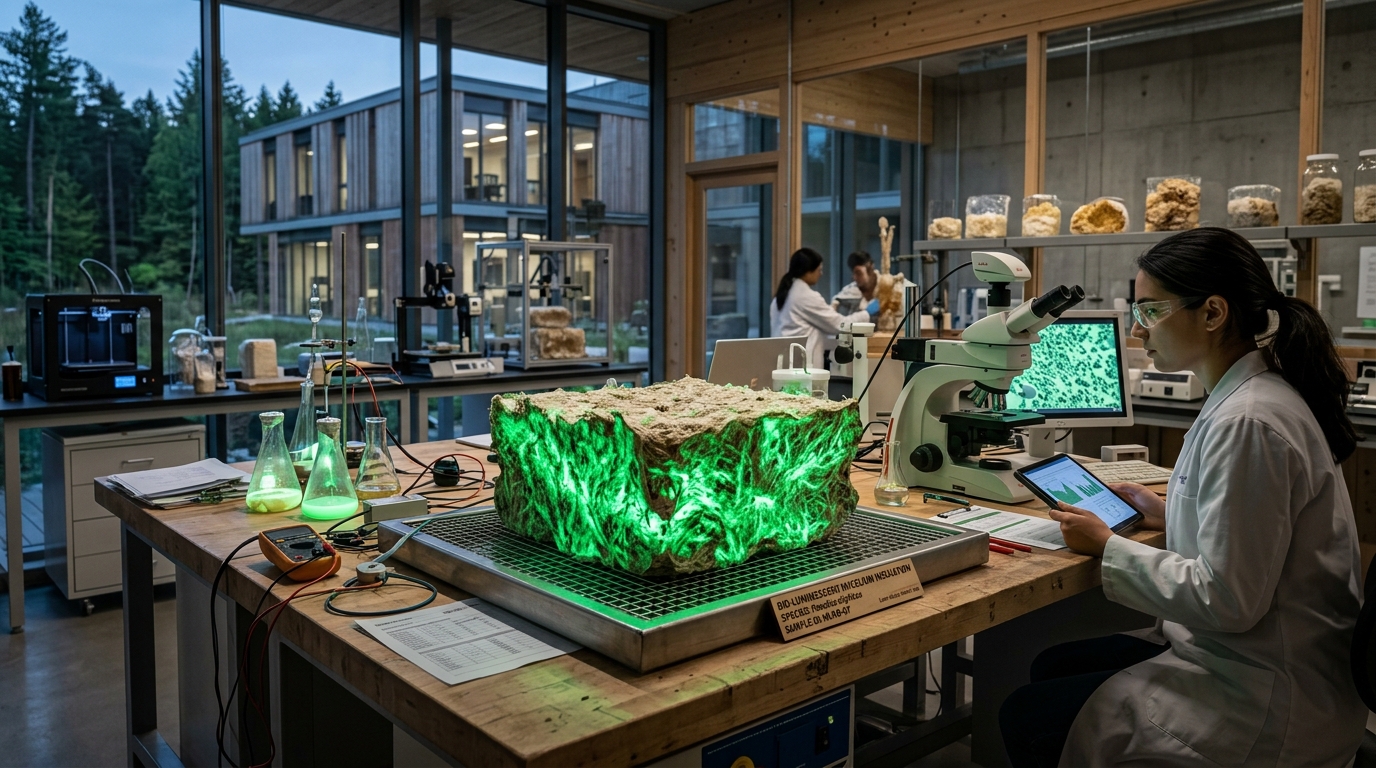
In this landscape of bio-inspired circular economy transitions, fungal mycelium biomaterials stand out as one of the most promising, bio-engineerable innovations. By harnessing the natural ability of macroscopic fungi to convert agricultural lignocellulosic waste into a dense, self-assembled Chitin-Glucan structural matrix, manufacturers can “grow” natural composite materials possessing exceptional thermal insulation, acoustic absorption, and inherent fire resistance—all while being 100% home compostable at end-of-life.
1. Biological Synthesis and Cultivation Kinetics: From Substrate to Structured Material
Mycelium constitutes the vegetative network of fungi, consisting of a dense thread-like branching network of micro-tubules known as hyphae. During bio-fabrication, mycelium functions as a natural, self-assembling biological binder, digesting and binding agricultural waste particles into a rigid structural composite.
[Agricultural Residues (Hemp Hurd / Straw)] ──(Inoculation: Ganoderma / Pleurotus Spores)──> [Dark Incubation Chamber (25°C, 90% RH)]
                                                                                                          │
                                                                                          (Hyphal Binding Phase: 5-8 Days)
                                                                                                          │
                                                                                          [3D Mold Shaping & Molding]
                                                                                                          │
                                                                                          (Thermal Deactivation: 80°C Dry)
                                                                                                          │
                                                                                         [Final Mycelium Composite Product]
Bio-Fabrication Process Stages
- Substrate Preparation & Sterilization: Utilizing locally sourced agricultural residues available at near-zero cost, such as hemp hurd, wheat straw, rice husks, or sawdust. Substrates are steam-pasteurized or autoclaved ($121^\circ\text{C}$) to eliminate competitive mold spores or bacteria.
- Fungal Inoculation: The substrate is inoculated with selected fungal strains (typically Ganoderma lucidum, Pleurotus ostreatus, or Trametes versicolor), selected for dense hyphal branching rates and strong secretion of ligninolytically active enzymes (laccases and peroxidases).
- Controlled Incubation & Growth: Inoculated mixtures are packed into 3D molds and placed in dark climatic growth chambers maintained at constant temperatures ($24^\circ\text{C} - 28^\circ\text{C}$) and high relative humidity ($85% - 95%$). Over 5 to 10 days, hyphae colonize and bind the substrate particles into a dense structural composite.
- Thermal Deactivation & Drying: Upon reaching target density, composites are removed from molds and oven-dried at $70^\circ\text{C} - 90^\circ\text{C}$. Heat treatment permanently halts fungal growth, inactivates spores, and removes residual moisture, mechanically stabilizing the bio-composite.
2. Material Engineering and Biomechanical Characterization
Mycelium bio-composites feature a porous cellular structure akin to synthetic polymer foams, combined with a fungal cell wall abundant in chitin and glucan polymers, imparting remarkable specific mechanical strength and natural fire protection.
Physical and Thermal Performance Properties
- Apparent Density: Tunable between $100\text{ kg/m}^3$ and $300\text{ kg/m}^3$, depending on compaction levels and substrate particle size distribution.
- Thermal Conductivity ($\lambda$): Ranges from $0.040\text{ W/m}\cdot\text{K}$ to $0.055\text{ W/m}\cdot\text{K}$. Thermal insulation performance directly matches mineral wool, glass wool, and expanded polystyrene (EPS).
- Acoustic Absorption Coefficient: Noise Reduction Coefficients (NRC) reach values between 0.75 and 0.90 across mid-to-high frequencies ($500 - 4000\text{ Hz}$), making mycelium panels ideal for interior acoustic remediation.
- Inherent Fire Resistance: The natural presence of nitrogen and chitin in fungal cell walls promotes char formation upon flame exposure. Mycelium composites achieve Euroclass B-s1,d0 fire ratings without requiring halogenated or toxic chemical flame retardant additives.
3. Industrial Applications: Protective Packaging and Bio-Construction
Form-factor versatility allows mycelium composites to target two massive, high-growth commercial markets.
┌────────────────────────────────────────────────────────────────────────────────────────┐
│                        INDUSTRIAL MYCELIUM APPLICATION FIELDS                          │
└────────────────────────────────────────────────────────────────────────────────────────┘
          │                                                                │
          ▼                                                                ▼
[Biodegradable Protective Packaging]                     [Sustainable Green Building Panels]
 - 100% replacement for EPS foam shapes                    - Thermal insulation wall panels
 - 100% home-compostable in 30-60 days                     - Interior acoustic wall baffles
 - Luxury goods & consumer electronics                     - Structural core composite materials
1. Industrial Protective Packaging (Myco-Packaging)
Custom-molded mycelium packaging shapes replace expanded polystyrene (EPS) inserts for shipping electronics, luxury cosmetics, wine bottles, and high-value consumer goods. Unlike EPS, mycelium packaging is 100% home-compostable: disposed of in garden soil or compost bins, it breaks down into organic soil nutrients within 30 to 60 days.
2. Sustainable Green Construction Insulation
In sustainable architecture, mycelium acoustic tiles and insulation boards provide non-toxic interior wall insulation. High water vapor permeability allows building envelopes to breathe, preventing moisture buildup, mold formation, and thermal bridging in energy-efficient buildings.
4. Performance & Sustainability Comparison Matrix
| Parameter / Material | Mycelium Composite | Expanded Polystyrene (EPS) | Polyurethane (PUR/PIR) | Mineral / Rock Wool |
|---|---|---|---|---|
| Feedstock Origin | Ag-Waste + Fungal Hyphae | Petroleum Derivatives | Petroleum Derivatives | Basaltic Rock / Glass |
| Thermal Conductivity ($\lambda$) | 0.040 – 0.055 W/m·K | 0.033 – 0.040 W/m·K | 0.022 – 0.028 W/m·K | 0.035 – 0.045 W/m·K |
| Embodied Carbon Footprint | Carbon Negative / Net Zero | High ($3.5 \text{ kgCO}_2/\text{kg}$) | Very High ($4.5 \text{ kgCO}_2$) | High ($1500^\circ\text{C}$ melting) |
| End-of-Life / Biodegradability | 100% Home Compostable | Incineration / Landfill | Incineration / Landfill | Special Landfill |
| Fire Safety Rating | Class B (Self-extinguishing) | Class E (Toxic smoke) | Class E-F (Halogenated additives) | Class A1 (Incombustible) |
| Microplastics / Toxicity | Zero | Microplastic shedding | Isocyanate / VOC off-gassing | Inhalable mineral fibers |
5. Investment Outlook and Mantohn SA Strategy
From a venture capital and private equity perspective, mycelium biomaterials combine low manufacturing CAPEX, decentralized regional scalability, and powerful regulatory tailwinds.
Key Investment Drivers:
- Capital-Efficient Vertical Bio-Factories: Mycelium growth facilities require no high-pressure autoclaves or high-temperature furnaces. Production can be organized into modular, regional vertical bio-factories sited adjacent to agricultural waste streams.
- Packaging Regulations (EU PPWR): Stricter plastic packaging taxes and bans on single-use EPS drive consumer brands toward multi-year off-take contracts for myco-packaging.
- Carbon Removal Credits: Because mycelium sequesters atmospheric carbon captured during photosynthesis by host crops, every ton of mycelium material acts as a durable carbon sink, unlocking high-integrity carbon credit revenues.
Mantohn SA actively invests in biotechnology scale-ups advancing automated bio-fabrication systems and fast-growing patented fungal strains.