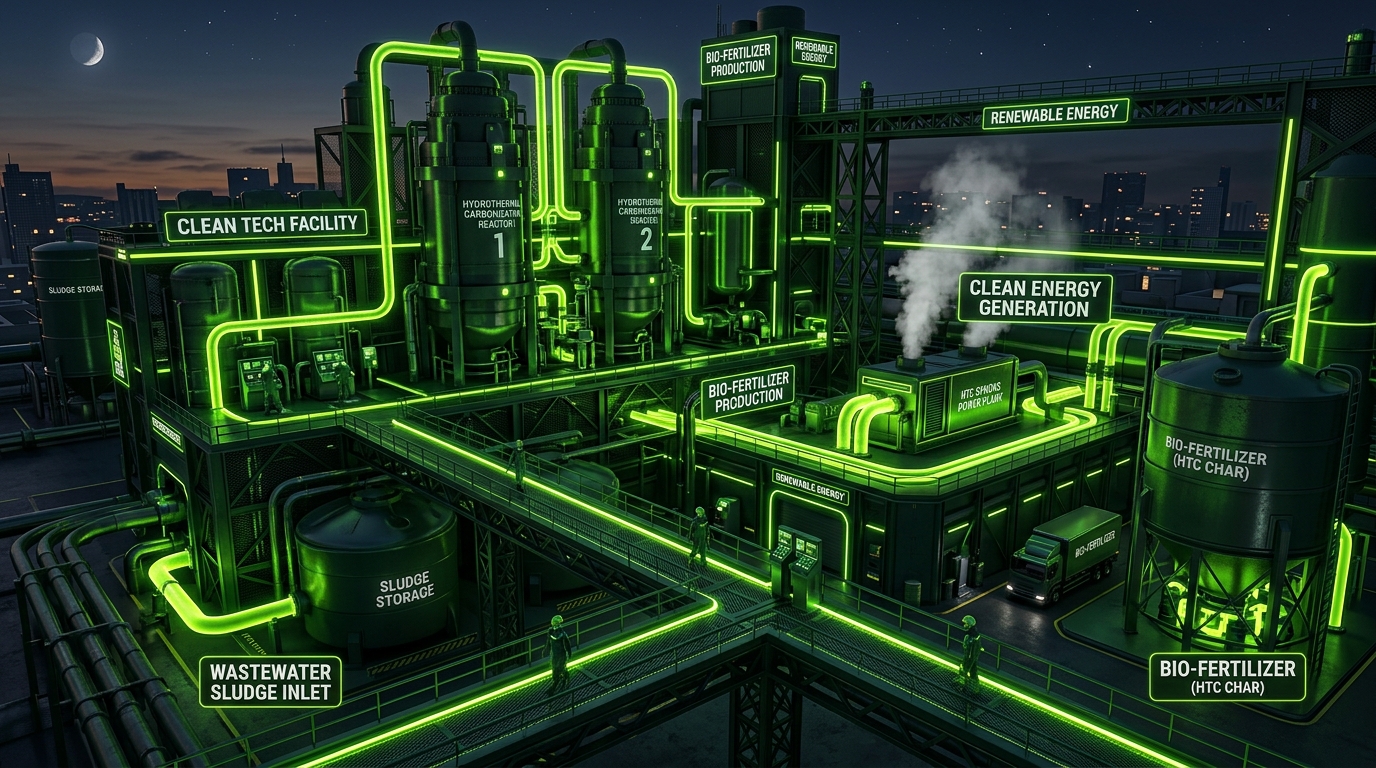
Treating municipal and industrial wastewater annually yields millions of tons of sewage sludge. Historically viewed as burdensome waste with high water content and potential contamination, sludge faces an unprecedented management crisis. Stricter regulatory limits on direct agricultural land spreading, emerging contaminants such as microplastics and per- and polyfluoroalkyl substances (PFAS), combined with surging landfill disposal costs, have rendered legacy disposal methods obsolete.
The Sludge-to-Value paradigm radically flips this perspective: organic and inorganic fractions within sludge are no longer seen as waste requiring disposal, but as a concentrated reservoir of bioenergy (biomethane), renewable phosphorus, and high-value agronomic biochar.
1. Sewage Sludge Management Crisis across Europe
Modern wastewater treatment plants (WWTPs) excel at purifying water, but concentrate virtually all pollutants within the solid-liquid sludge matrix.
Key Industry Challenges:
- PFAS and Persistent Pollutant Contamination: Accumulation of hydrophobic synthetic chemicals makes raw sludge spreading on agricultural soils hazardous, leading several European countries (Germany, Switzerland, Austria) to ban the practice.
- High Moisture Content: Mechanically dewatered sludge still retains 75% to 85% water. Transporting water creates immense logistical inefficiencies and a heavy carbon footprint.
- EU Urban Wastewater Treatment Directive (UWWTD) Revision: Updated EU legislation mandates energy neutrality for larger wastewater treatment facilities and introduces mandatory phosphorus recovery prior to final disposal.
                  +-------------------------------------------------------+
                  |              RAW SEWAGE SLUDGE MATRIX                 |
                  |         (Water Content: 80% | Solid: 20%)           |
                  +-------------------------------------------------------+
                                              │
                    ┌─────────────────────────┴─────────────────────────┐
                    ▼                                                   ▼
     [LEGACY DISPOSAL (DECLINING)]                     [ADVANCED SLUDGE-TO-VALUE PLATFORM]
     - Direct land application (PFAS risk)             - Thermal Hydrolysis + Anaerobic Digestion
     - Landfilling (Banned/Taxed)                      - Hydrothermal Carbonization (HTC)
     - Direct incineration (High energy input)         - Mono-Incineration + Phosphorus Recovery
2. Sludge-to-Value Technological Platforms
Converting sludge requires a cascaded combination of biological, chemical, and thermal processes to maximize energy recovery and extract mineral nutrients.
[Wet Sludge] ➔ [Thermal Hydrolysis THP] ➔ [Anaerobic Digestion] ➔ [Biogas / Biomethane]
                                                │
                                                ▼ (Digested Sludge)
                                    [HTC Carbonization / Drying]
                                                │
                                                ▼
                                    [Hydrochar / Mono-Incineration]
                                                │
                                                ▼
                                    [Phosphorus & Struvite Recovery]
A. Thermal Hydrolysis (THP) & Advanced Anaerobic Digestion
Integrating Thermal Hydrolysis (THP) prior to anaerobic digestion operates as an industrial pressure cooker ($160^\circ C - 180^\circ C$ at $6 - 12\text{ bar}$). This step ruptures bacterial cell walls within sludge, rendering organic matter instantly available to methanogenic microbes.
- Benefits: Boosts biogas production by 30–50%, reduces final digestate volume by 30%, completely sterilizes pathogens, and significantly improves residual dewaterability.
B. Hydrothermal Carbonization (HTC)
HTC is a thermochemical process ideal for high-moisture matrices like sludge. Operating wet ($180^\circ C - 250^\circ C$ under autogenous pressure), HTC mimics geological coal formation in just 2 to 4 hours.
- Outputs: Yields a synthetic coal termed Hydrochar, which dewaters effortlessly. Hydrochar possesses calorific values comparable to lignite and serves as renewable solid fuel or an industrial metallurgy reducing agent.
C. Mono-Incineration & Ash Phosphorus Recovery
Because phosphorus is a critical raw material on the EU strategic list, recovering it from sewage sludge is paramount for continental food security.
Mono-incineration (combusting dried sludge exclusively without mixing other waste) yields ash rich in phosphorus pentoxide ($P_2O_5$, up to 15–20%). Acid leaching of ash or chemical precipitation as Struvite (magnesium ammonium phosphate) produces a high-value slow-release fertilizer completely free of organic pollutants and PFAS, which are destroyed by high combustion temperatures ($>850^\circ C$).
3. Sludge Valorization Technology Matrix
| Technical Parameter | Direct Drying & Combustive Burning | Hydrothermal Carbonization (HTC) | THP + Digestion + Phosphorus Recovery |
|---|---|---|---|
| Matrix Moisture Handling | Requires deep drying (energy intensive) | Processes wet matrices directly | Processes wet matrices before digestion |
| Final Energy Vector | Steam / Electricity | Solid Hydrochar (high LHV) | Grid-injected Biomethane ($CH_4$) |
| Phosphorus Yield | Low / Diluted in mixed ash | Medium (retained in hydrochar/liquid) | Very High ($>80%$ from mono-incineration ash) |
| PFAS / Pollutant Destruction | Complete ($>850^\circ C$) | Partial / Pending effluent analysis | Complete in dedicated thermal stage |
| Net Energy Balance | Often negative or neutral | Positive (low thermal input) | Strongly Positive (facility self-sufficiency) |
4. Economic, Regulatory, and ESG Landscape
Implementing Sludge-to-Value technologies turns wastewater treatment plants from municipal cost centers into Revenue Generators.
Revenue Structure for a Model Facility
- Gate Fees: Stable revenue derived from accepting wet sludge from municipal WWTPs or industrial districts.
- Advanced Biomethane Sales: State and European incentives for grid injection or bio-CNG/bio-LNG heavy transport fuel distribution.
- Renewable Fertilizer Commercialization (Struvite/Phosphoric Acid): Selling purified phosphorus to precision agriculture, replacing imported synthetic fertilizers from non-EU markets.
- Hydrochar or Carbon Credit Sales: Direct energy monetization or carbon sequestration across qualified industrial supply chains.
5. Mantohn SA Investment Vision
Mantohn SA views Water & Sludge Management as a priority investment area for continental infrastructure resilience. Scarcity of primary mineral phosphorus combined with European directives mandates rapid deployment of advanced Sludge-to-Value facilities.
Supporting modular thermal hydrolysis units, HTC plants, and struvite crystallization reactors completes local water and nutrient loops. For institutional investors, circular sludge management delivers cash flows decorrelated from traditional macroeconomic cycles, backed by strict environmental mandates and high ESG metrics.
Sewage sludge is no longer the end of the water treatment cycle; it is the origin of the new circular bioeconomy for phosphorus and green energy.