The global plastic waste crisis represents one of the most urgent environmental and industrial challenges of the twenty-first century. Worldwide, over 400 million metric tons of synthetic polymers are produced annually, yet less than 10% is effectively recycled into high-value applications. Traditional mechanical recycling (shredding, washing, melting, and extrusion) faces insurmountable physical limitations: each thermal melt cycle degrades polymer chain lengths, impairing mechanical properties (downcycling). Furthermore, mechanical recycling cannot process multi-layer flexible packaging, heavily contaminated post-consumer plastics, mixed polyolefins (HDPE, LDPE, PP), or dark-pigmented materials.
Consequently, the vast majority of hard-to-recycle plastic waste ends up incinerated (releasing fossil $CO_2$) or buried in landfills.
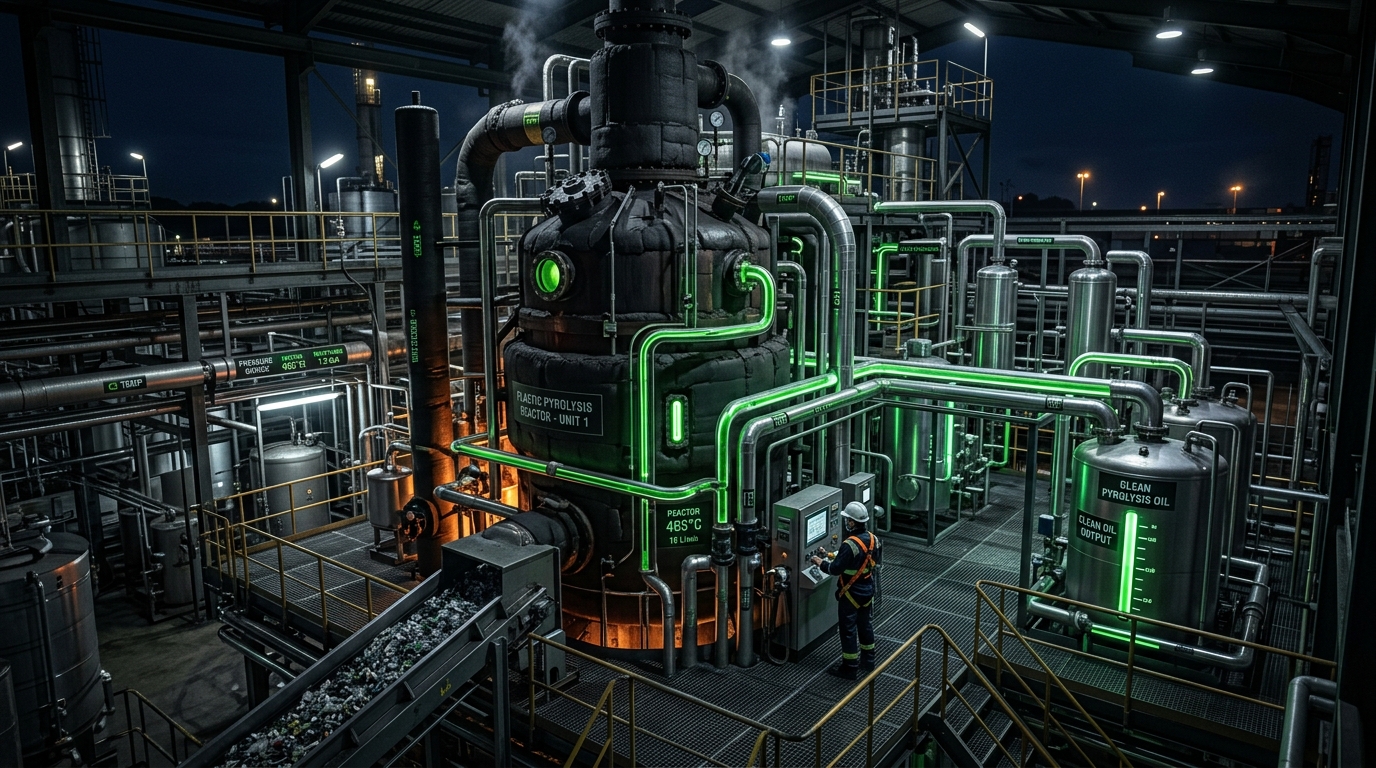
In this context, chemical recycling via thermal and catalytic pyrolysis emerges as the breakthrough industrial technology capable of fully closing the circular economy loop. By thermally depolymerizing plastic waste back into primary monomeric hydrocarbon building blocks, pyrolysis yields high-grade Taco Pyrolysis Oil (TPO). This oil serves as a direct drop-in replacement for fossil naphtha in petrochemical steam crackers, enabling the synthesis of virgin-grade, food-contact plastic polymers.
1. Thermochemical Kinetics of Pyrolysis: Breaking C-C Bonds
Plastic pyrolysis is a thermal decomposition process operating in complete absence of oxygen (under an inert nitrogen or recycled gas blanket) at temperatures between $400^\circ\text{C}$ and $700^\circ\text{C}$ at atmospheric pressure.
Under thermal excitation, long-chain polymer macromolecules (PE, PP, PS) undergo random or end-chain scission of covalent carbon-carbon ($C-C$) bonds along the polymer backbone. This breaks the solid plastic down into short-chain hydrocarbons: non-condensable syngas ($C_1 - C_4$), condensable liquid hydrocarbon vapors ($C_5 - C_{35}$ alkanes, alkenes, aromatics), and solid carbonaceous char.
[Mixed Plastic Waste (PE/PP/PS)] ──(Pre-treatment & Extrusion)──> [Molten Polymer (300°C)]
                                                                          │
                                                      (Pyrolysis Reactor: 450°C - 550°C)
                                                                          │
       ┌──────────────────────────────────────────────────────────────────┴────────────────────────────────┐
       ▼                                                                                                   ▼
[Solid Residue: Char & Ash]                                                            [Pyrolysis Vapors (Condensation)]
                                                                                                           │
                                                                           ┌───────────────────────────────┴───────────────────────────────┐
                                                                           ▼                                                               ▼
                                                              [Non-Condensable Gas (C1-C4)]                                     [Raw Pyrolysis Oil (TPO)]
                                                              (Process Thermal Auto-consumption)                                                │
                                                                                                                                (Hydrotreating & Cleanup)
                                                                                                                                            │
                                                                                                                                [Circular Naphtha / Feedstock]
Thermal vs. Catalytic Depolymerization Mechanisms
- Pure Thermal Pyrolysis ($500^\circ\text{C} - 700^\circ\text{C}$): Requires high thermal energy and produces a broad hydrocarbon spectrum (ranging from light gasolines to heavy waxes $C_{30+}$), containing high olefin content requiring extensive downstream hydrotreating.
- Catalytic Pyrolysis ($380^\circ\text{C} - 500^\circ\text{C}$): Introducing acidic zeolite catalysts (such as ZSM-5, USY, or HY) dramatically lowers reaction activation energy. Catalysts sharpen process selectivity toward high-value liquid fractions ($C_5 - C_{12}$ aromatic naphtha cut), minimizing unwanted wax production.
2. Feedstock Preparation and Contaminant Dehalogenation
Industrial viability and bankability of pyrolysis plants depend heavily on rigorous feedstock sorting and robust oil purification systems.
Primary Contaminants and Poisoning Agents
- Chlorine and Halogens (from PVC / PVDC): PVC decomposes at low temperatures ($250^\circ\text{C}-350^\circ\text{C}$), generating corrosive hydrogen chloride gas ($HCl$). $HCl$ corrodes reactors and poisons hydrotreating catalysts. Installing a thermal de-chlorination extruder ($300^\circ\text{C}$) prior to the main reactor is strictly mandatory to strip chlorine below 10 ppm.
- Oxygenates and Terephthalic Acid (from PET): PET contains oxygen. Pyrolyzing PET yields solid terephthalic acid which sublimes, clogging pipelines and condenser units while generating non-condensable $CO$ and $CO_2$. PET must be removed optically prior to pyrolysis.
- Nitrogen and Silicon (from Polyurethanes and Additives): Produce organonitrogen species and siloxanes that foul downstream petrochemical steam cracker catalysts.
3. Pyrolysis Oil Refining (TPO Upgrading) and Steam Cracker Integration
Raw pyrolysis oil cannot be fed directly into commercial petrochemical steam crackers without undergoing hydrotreating upgrading.
Key Upgrading Steps:
- Catalytic Hydrotreating (Hydrodesulfurization & Hydrodenitrogenation): Operating under hydrogen pressure ($30 - 80\text{ bar}$) at $300 - 380^\circ\text{C}$, hydrotreating strips residual chlorine ($< 10\text{ ppm}$), nitrogen, and metals while saturating unstable olefins.
- Fractional Distillation: Separates upgraded liquid into distinct commercial cuts:
- Naphtha Cut ($C_5 - C_{11}$): Premium feed for steam crackers producing virgin-grade ethylene and propylene.
- Diesel Cut ($C_{12} - C_{20}$): High-cetane industrial synthetic fuel or lubricant basestock.
- Heavy Bottoms ($C_{21+}$): Recycled back into the pyrolysis reactor core.
Plastics manufactured from certified circular pyrolysis naphtha achieve ISCC PLUS (International Sustainability and Carbon Certification) status based on mass balance accounting, allowing consumer packaging brands to certify 100% recycled content.
4. Mass and Energy Balance of Industrial Pyrolysis
A state-of-the-art plastic pyrolysis facility operates near thermal self-sufficiency. Non-condensable process gases ($C_1 - C_4$) generated during cracking are recirculated into reactor combustion chambers to supply heat for the endothermic reaction.
| Parameter / Yield | Typical Value (PE/PP Polyolefin Mix) | Operational Detail |
|---|---|---|
| Liquid Pyrolysis Oil (TPO) Yield | 70% – 85% by weight | Primary economic output stream for petrochemical off-take |
| Non-Condensable Gas Yield | 10% – 20% by weight | Fully utilized for plant internal process heating |
| Solid Char Yield | 3% – 8% by weight | Carbonaceous residue containing inert mineral fillers (TiO2, CaCO3) |
| Specific Energy Consumption | $0.9 - 1.2 \text{ kWh/kg}$ plastic | ~80% covered by internal off-gas combustion |
| Lifecycle GHG Reduction (LCA) | 50% – 60% vs. Incineration | Prevents direct fossil combustion emissions |
5. Investment Outlook and Mantohn SA Strategy
For private equity, venture capital, and infrastructure funds, chemical recycling via plastic pyrolysis represents one of the most compelling investment thesis within the circular economy sector.
Key Financial & Regulatory Drivers:
- Mandatory Recycled Content Mandates: European Union regulations (such as PPWR) mandate binding post-consumer recycled content targets in plastic packaging by 2030 (up to 30% for food-contact items), targets unachievable via mechanical recycling alone.
- Circular Premium Pricing: ISCC+ certified circular naphtha commands a 50% to 100% price premium over fossil naphtha, driving plant EBITDA margins above 35–40%.
- Petrochemical Off-Take Partnerships: Global chemical majors (LyondellBasell, SABIC, Dow, TotalEnergies) are entering long-term take-or-pay off-take agreements to secure certified pyrolysis oil feedstocks.
Mantohn SA actively structures and invests in advanced pyrolysis ventures equipped with continuous inline de-chlorination and integrated hydrotreating technologies.