The global economy is undergoing a epochal transition, driven by the dual necessity of industrial decarbonization and energy infrastructure digitization. However, this structural shift has highlighted a critical vulnerability: dependence on highly concentrated supply chains for Critical Raw Materials (CRMs), such as lithium, cobalt, nickel, rare earth elements (REE), gallium, and platinum group metals (PGM).
Amid geopolitical tensions and potential primary resource scarcity, conventional mining paradigms are evolving. The true frontier of material security is found not in traditional sub-surface mines, but inside industrial waste deposits, flue gas dusts, metallurgical residues, and Waste Electrical and Electronic Equipment (WEEE).
This transformation, known as Urban and Industrial Mining, represents an extraordinary financial and technological opportunity for institutional investors and forward-thinking industrial holdings.
1. Material Geopolitics and the Critical Raw Materials Act
The international regulatory framework, spearheaded in Europe by the Critical Raw Materials Act, sets binding and ambitious targets for 2030:
- At least 10% of the EU’s annual critical raw material consumption must originate from internal extraction.
- At least 25% of consumption must come from recycling and upcycling of waste streams.
- No more than 65% of the Union’s annual demand for any refined critical raw material may depend on a single third country.
+-----------------------------------------------------------------------------+
|                      CRITICAL RAW MATERIALS ACT (2030)                       |
+-----------------------------------------------------------------------------+
| [Internal Extraction: >= 10%] | [Recycling & Upcycling: >= 25%] | [Third-Country Cap: <= 65%] |
+-----------------------------------------------------------------------------+
                                       |
                                       v
          +---------------------------------------------------------+
          |  INDUSTRIAL MINING: EFFLUENT TRANSFORMATION             |
          |  - Steel Slags & EAF Dust (Zn, Pb, In)                  |
          |  - Red Mud / Bauxite Residues (REE, Sc, Ti)             |
          |  - WEEE & Battery Black Mass (Li, Co, Ni, Mn)           |
          +---------------------------------------------------------+
Dependence on single-nation monopolies for strategic metal refining exposes Western markets to systemic supply chain risks. Recovering high-purity elements from complex waste matrices is no longer merely an eco-friendly initiative; it is a strategic imperative for industrial sovereignty.
2. Waste Matrices with Highest Elemental Value
High-mineral-density industrial waste streams are not homogeneous and require differentiated technological strategies. Principal high-value streams include:
A. Flue Dust & Steelmaking Slags
Electric Arc Furnaces (EAF) generate tons of volatile dusts rich in heavy metals, particularly zinc, lead, indium, and cadmium. Valorizing these residues converts toxic waste incurring heavy disposal fees into concentrated mineral reserves.
B. Bauxite Residues (“Red Mud”)
The Bayer process for alumina production generates massive volumes of highly alkaline red mud. These byproducts harbor significant concentrations of scandium, titanium, iron, and heavy rare earth elements. Neutralization and selective extraction unlock previously inaccessible value.
C. Lithium Battery Black Mass & Electronic Waste (WEEE)
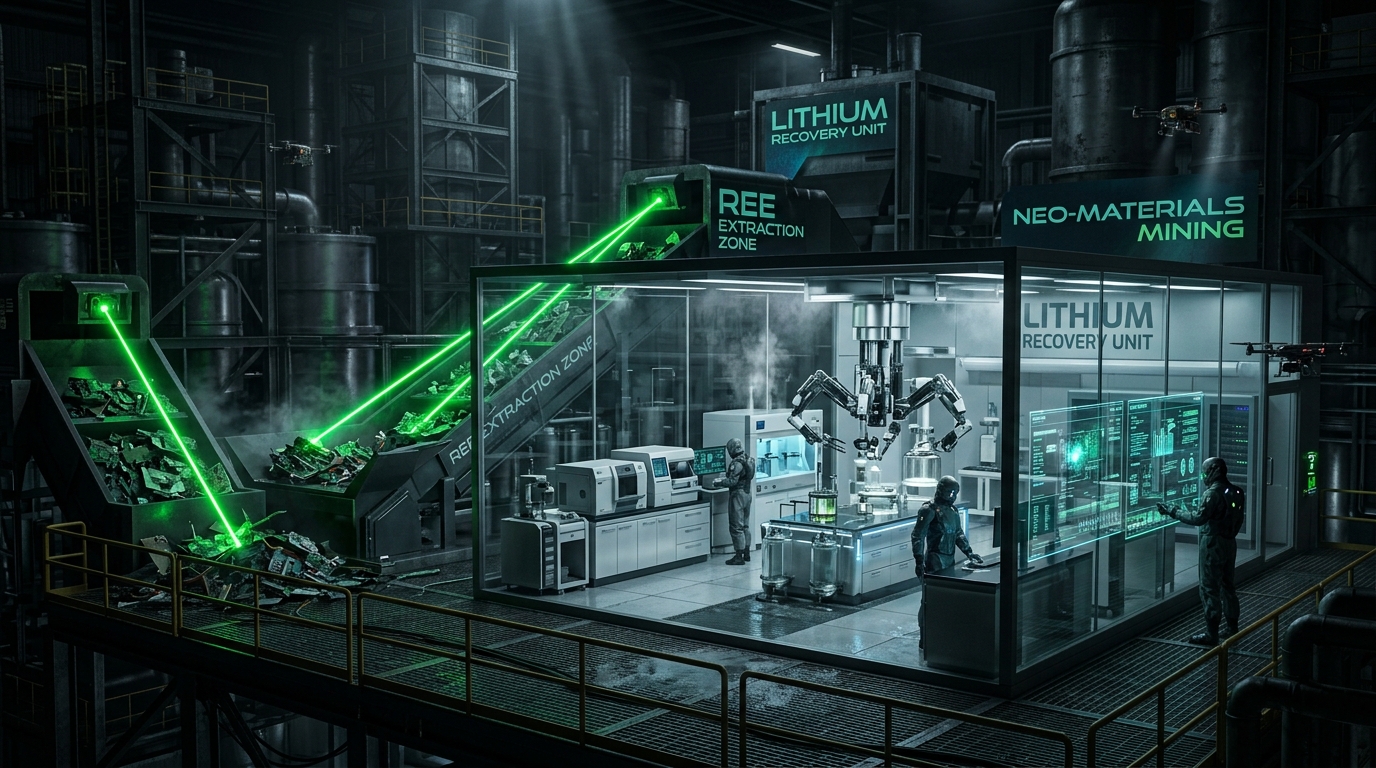
End-of-life battery recycling (EV and energy storage) produces black mass — a powder rich in lithium, cobalt, nickel, and manganese. Concurrently, printed circuit boards (PCBs) in WEEE exhibit gold, silver, palladium, and copper concentrations several orders of magnitude higher than virgin ores mined traditionally.
3. Cutting-Edge Technologies in Elemental Recovery
Transitioning from simple mechanical recycling to high-purity elemental recovery (battery or metallurgical grade) demands third- and fourth-generation physical-chemical processing.
Waste Matrix ➔ [Mechanical/Physical Pre-treatment]
                      │
                      ▼
        [Hydrometallurgical Leaching / DES]
                      │
                      ▼
         [Solvent Extraction / Bio-leaching]
                      │
                      ▼
     [Selective Precipitation / Electrowinning] ➔ [Pure Metal (99.9%+)]
1. Advanced Hydrometallurgy & Solvometallurgy
Unlike energy-intensive pyrometallurgical methods (which melt matter by burning organic components and emitting CO₂), hydrometallurgy uses low-temperature aqueous solutions (acids or bases) to selectively dissolve target metals. Recent advances deploy Deep Eutectic Solvents (DES) and ionic liquids — green, reusable solvents capable of dissolving complex metal oxides with near-zero environmental footprints.
2. Bio-Leaching
Biological extraction leverages microorganisms (acidophilic bacteria such as Acidithiobacillus ferrooxidans) to solubilize precious metals and rare earths from low-concentration mineral matrices. This low-energy, low-OpEx approach is ideal for remediating and valorizing legacy metallurgical slag heaps.
3. Chemical Refining & Selective Precipitation
Once metals are solubilized in liquid phases, organic-solvent extraction, ion-exchange membranes, or fractional crystallization techniques isolate individual chemical elements with high purity levels (>99.99%), suitable for direct re-entry into semiconductor or electrochemical supply chains.
4. Comparative Matrix: Traditional Mining vs. Urban/Industrial Mining
The table below highlights the economic and environmental superiority of elemental recovery over conventional primary extraction:
| Metric Parameter | Traditional Mining | Upcycling & Industrial Waste Recovery |
|---|---|---|
| Metal Concentration (e.g., Au/Cu in WEEE vs Ore) | 1 – 10 g/t of mined ore | 100 – 1,000 g/t of processed matrix |
| Specific Water Consumption | Extremely High (millions m³/year) | Low (-60% to -85% via closed-loop recycling) |
| Carbon Footprint (tCO₂/t metal) | Very High (extraction, crushing, smelting) | Low (-50% to -80% using hydrometallurgy) |
| Permitting & Commissioning Lead Times | 8 – 15 years (new greenfield mines) | 2 – 4 years (brownfield industrial plants) |
| Geopolitical & Supply Chain Risk | High (third-country concentration) | Localized (regional/near-shore supply chains) |
| Social Acceptability & Operating License | Challenging (landscape & ecological impact) | Positive (remediation & landfill diversion) |
5. Business Model and Investment Outlook
Investing in elemental recovery from industrial waste offers an asymmetric risk-return profile highly attractive to private and institutional capital.
Multiple Revenue Streams:
- Gate Fees (Tipping Fees): Operators collect fees from waste producers for compliant management and treatment of hazardous waste (e.g., EAF dust or toxic sludge).
- Sale of High-Purity Metals & Chemical Intermediates: Commercialization of battery-grade metals (e.g., nickel sulfate, lithium hydroxide, cathode zinc) at market prices or ESG premium pricing.
- Carbon Credits & Sustainability Certificates: Generating credits on EU ETS or voluntary markets linked to avoided emissions relative to primary ore extraction.
Strategic Outlook for Mantohn SA
Mantohn SA identifies proprietary hydrometallurgy, slag valorization, and black mass refining technologies as core pillars for heavy industry decarbonization. Through structured partnerships with steelmakers, gigafactories, and waste management authorities, Mantohn drives investment in modular, scalable infrastructure (Modular Extraction Units) that secures operational resilience and long-term financial returns.
Transitioning from waste to critical raw materials is not merely an ecological conversion; it marks the birth of Circular Resource Engineering as a new asset class.