
The Voluntary Carbon Market (VCM) is undergoing the most profound transformation in its history. Over the past five years, regulatory pressure, rigorous academic audits, and investigative media reports have laid bare the structural vulnerabilities of early-generation environmental offsets.
Allegations of greenwashing, “phantom” credits based on hypothetical avoided deforestation baselines, and double counting (double counting) have eroded the confidence of institutional investors and global corporations pursuing Net Zero targets.
To transition carbon credits from controversial reputational tools into financially bankable, transparent, and highly liquid asset classes, the industry is globally adopting end-to-end digital traceability. The convergence of Internet of Things (IoT) sensors, satellite remote sensing, artificial intelligence, and immutable distributed ledgers (Distributed Ledger Technology / Blockchain) is spawning the architecture of digital Monitoring, Reporting, and Verification (dMRV).
In this article, we examine how digital traceability is eliminating greenwashing in the VCM, establishing the high transparency standards required to unlock major institutional capital.
1. The VCM Trust Deficit: Three Structural Flaws
To appreciate the value of digital transparency, one must analyze the vulnerabilities that plagued the first era of carbon offsets. Legacy systems relied almost exclusively on analogue verification, manual sampling conducted at multi-year intervals, and isolated centralized registries lacking real-time interoperability.
Legacy Model (Vulnerable):
[Paper-Based Theoretical Estimates] ──> [Sporadic Manual Audits] ──> [Isolated PDF Registry] ──> Greenwashing / Double Counting Risk
A. Lack of Additionality and Phantom Baselines
In traditional avoidance projects, such as forest conservation (REDD+), generated credits depended on hypothetical counterfactuals: “what would have happened to the forest without the project?”. Overinflated baselines flooded the market with hundreds of millions of credits delivering zero real net climate benefit.
B. Opaque Supply Chains & Absence of Traceability
For decades, corporate buyers could rarely trace a credit serial number back to exact GPS coordinates or real-time production logs. This opacity enabled speculative intermediaries to extract high margins along the financial chain.
C. Double Counting Vulnerabilities
Lacking real-time global synchronization across international registries, a single carbon credit could be claimed simultaneously by a corporate buyer for CSR reporting and by a host nation toward its Nationally Determined Contributions (NDCs) under Article 6 of the Paris Agreement.
2. Technical Architecture of dMRV: From Physical Measurement to Token
Industry’s answer is the dMRV (digital Monitoring, Reporting, and Verification) protocol. Unlike traditional paper-based auditing, dMRV automates the full lifecycle of environmental claims by introducing continuous measurement directly at the physical source.
┌────────────────────────┐      ┌────────────────────────┐      ┌────────────────────────┐      ┌────────────────────────┐
│  Edge IoT Devices      │ ───► │ Remote Sensing & AI    │ ───► │ dMRV Smart Contracts   │ ───► │ Blockchain Registry    │
│  (Industrial Sensors)  │      │ (Sentinel / LiDAR)     │      │ (Algorithmic Valid.)   │      │ (Unique dCDR Asset)    │
└────────────────────────┘      └────────────────────────┘      └────────────────────────┘      └────────────────────────┘
1. On-Site Data Ingestion (IoT & Edge Computing)
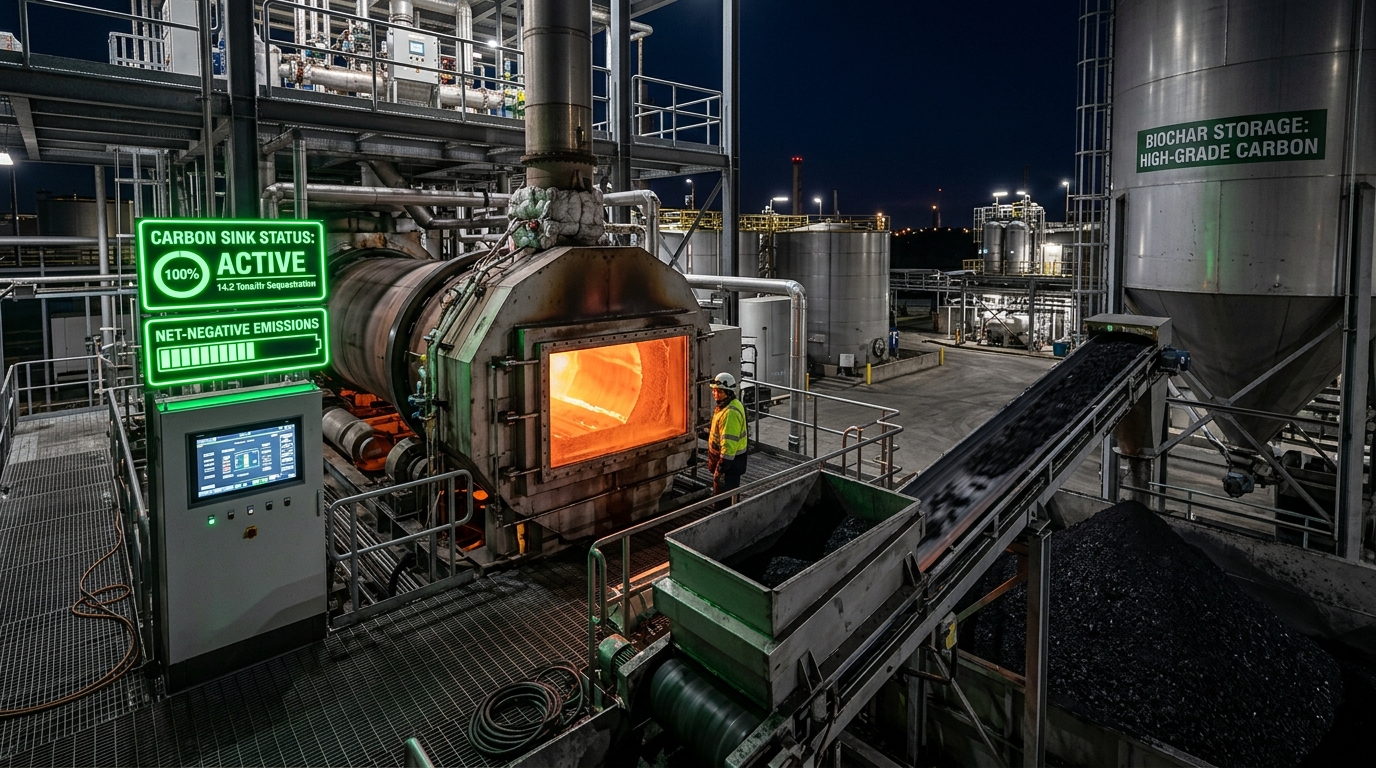
For durable carbon removal (CDR) technologies like biochar, dMRV architecture originates directly inside pyrolysis reactors:
- Hardware-sealed, encrypted industrial sensors continuously capture incoming biomass weight, core reactor temperatures (> 550°C), moisture levels, and flue gas flows.
- Utilizing hardware root-of-trust modules, telemetry data is cryptographically signed at the source, preventing retrospective tampering.
2. Satellite Validation & Geospatial Analysis (Remote Sensing)
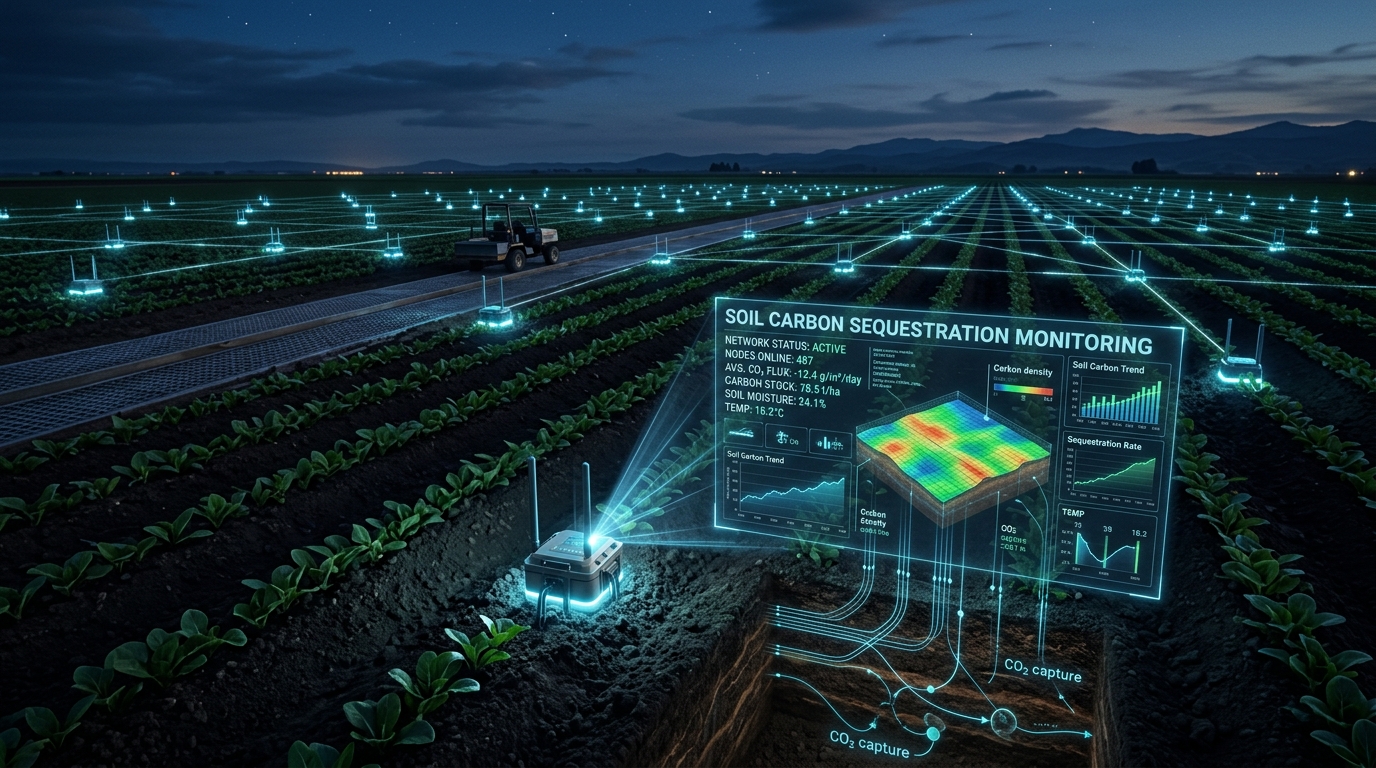
In associated agro-forestry or agricultural projects, ground IoT streams are cross-verified against high-resolution satellite constellations (such as ESA Sentinel-2) and LiDAR arrays:
- Machine Learning algorithms analyze Normalized Difference Vegetation Index (NDVI), canopy moisture stress, and Soil Organic Carbon (SOC) dynamics.
- Weather anomalies, wildfires, or land disturbances are flagged within 24–48 hours, automatically updating project risk ratings.
3. Distributed Ledger Notarization (Blockchain)
Once processed and verified against methodology algorithms, data is dispatched to a high-throughput, energy-efficient public Blockchain or dLT (Proof-of-Stake):
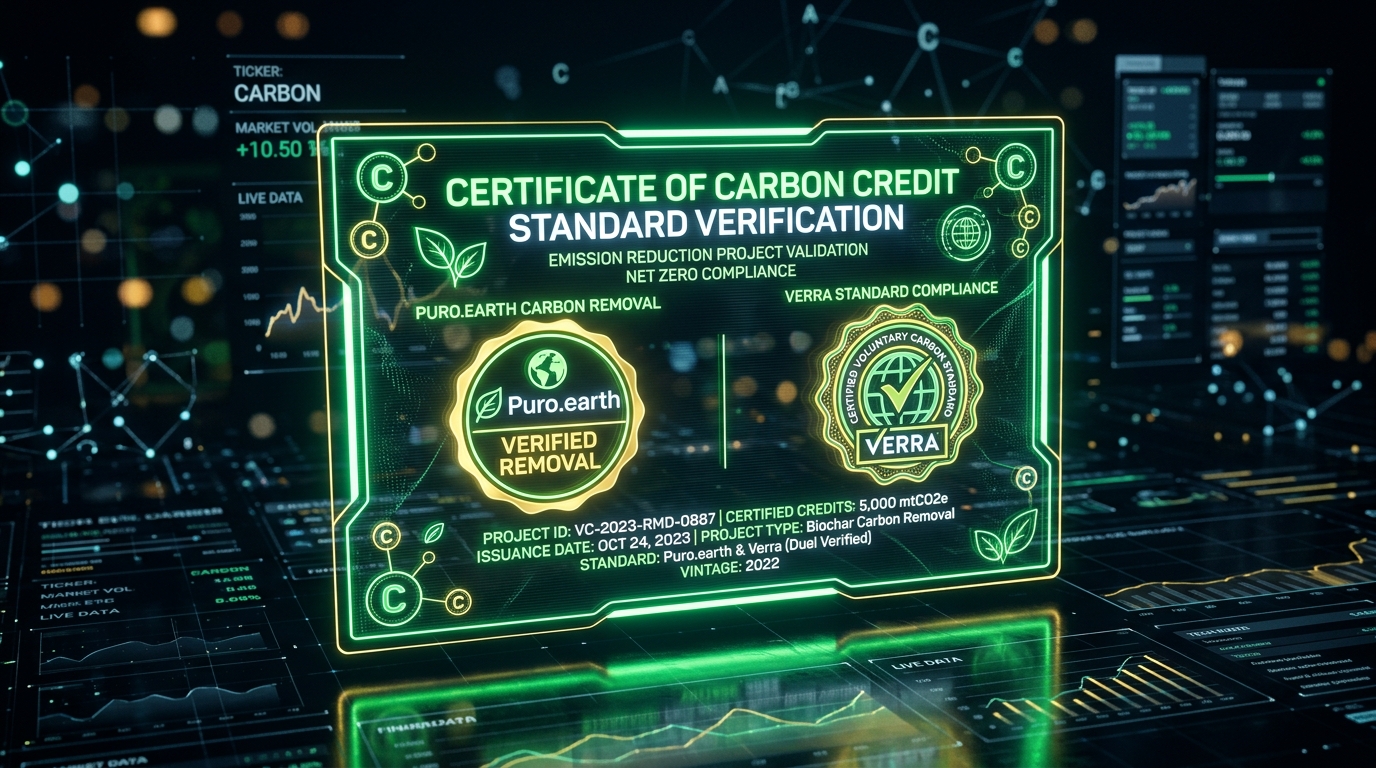
- A non-fungible/fractional Digital Twin or dCDR (digital Carbon Dioxide Removal) token is minted.
- Each token embeds immutable metadata: GPS coordinates, exact pyrolysis timestamp, batch H/Corg ratio, soil receiver suitability, and laboratory assay certificates.
3. Systemic Comparison: Traditional Offsets vs. Digital CDR Credits
The table below contrasts legacy avoidance offsets with new digital removal credits (dCDR) backed by biochar and dMRV:
| Feature | Legacy Offsets (Avoidance/Analogue) | Digital dCDR Credits (Biochar/dMRV) |
|---|---|---|
| Impact Type | Hypothetical avoidance of future emissions | Physically measured net CO₂ removal |
| Permanence | Low (20–50 years, vulnerable to fires/logging) | Exceptional (> 1,000 years in graphitic lattice) |
| Verification Frequency | Sampled manual audits every 3–5 years | Continuous real-time IoT/Satellite telemetry |
| Greenwashing Risk | High (frequent legal/reputational challenges) | Near zero (public data auditability) |
| Registry & Settlement | Isolated PDF ledgers & opaque brokerages | Immutable Blockchain, smart contracts & dLT |
| Bankability & Price | Low ($2 – $10 / t CO₂e) | High ($110 – $180 / t CO₂e) |
4. Global Governance: ICVCM Standards & Core Carbon Principles (CCPs)
Digital traceability operates alongside emerging global regulations shaping carbon finance.
The Integrity Council for the Voluntary Carbon Market (ICVCM) introduced the Core Carbon Principles (CCPs) — ten benchmark rules defining scientific integrity and transparency across carbon markets:
[Core Carbon Principles (ICVCM)]
 ├── 1. Rigorous Real Additionality
 ├── 2. Long-Term Permanence (> 100 Years)
 ├── 3. Robust Measurement & dMRV Traceability
 ├── 4. No Double Counting (Paris Agreement Art. 6)
 └── 5. Financial Transparency & ESG Co-Benefits
Through dMRV adoption:
- Financial Flow Transparency: Smart contracts track the exact percentage of credit sales routed directly to local communities or farmers applying biochar, eliminating predatory broker markups.
- Paris Agreement Article 6 Compliance: Distributed digital registries interface directly with sovereign state databases, triggering automated Corresponding Adjustments (CA) to prevent double claiming.
5. Mantohn SA Vision: De-Risking Impairment Across ESG Portfolios
From a capital allocation standpoint, opaque legacy carbon credits represent significant balance sheet and reputational impairment risk for portfolio companies, institutional funds, and Family Offices.
Acquiring low-quality offsets exposes corporate balance sheets to sudden write-downs when regulatory authorities (such as the SEC or ESMA) challenge environmental claims in sustainability filings (CSRD).
At Mantohn SA, our carbon market and biochar investment strategy centers on three core principles:
- Exclusive Focus on Removal Technologies (CDR): We prioritize capital allocation toward pyrolysis infrastructure capable of locking carbon into durable matrices for over a millennium.
- Native dMRV Integration: Every facility and project funded across our ecosystem embeds encrypted IoT sensing and transparent ledgers from day one (security & data integrity by design).
- Environmental Asset Interoperability: We drive convergence between traditional finance and digital markets, enabling tokenized carbon credits to serve as liquid collateral for green structured credit and project finance.
Digital traceability is not a bureaucratic overhead; it is the vital catalyst transforming carbon markets into powerful levers for reallocating global capital toward industrial and ecological transition.