The Voluntary Carbon Market (VCM) and compliance carbon offset markets face a severe structural credibility crisis. Traditional Measurement, Reporting, and Verification (MRV) frameworks—relying on paper-based reporting, periodic manual field sampling, annual third-party auditor visits, and simplified mathematical estimations—have proven slow, expensive, opaque, and highly susceptible to over-crediting and greenwashing controversies.
Institutional investors, corporate carbon buyers, and ESG funds now demand bankable, audit-grade verification standards: guaranteed real additionality, immutable chain-of-custody tracking, and real-time monitoring of carbon permanence.
In this landscape of digital environmental asset transformation, digital Measurement, Reporting, and Verification (dMRV) architectures—integrating edge IoT sensor networks, continuous satellite remote sensing, AI telemetry analytics, and immutable blockchain ledgers—represent the essential technological paradigm shift. By fully automating the carbon dioxide removal ($CO_2$ / CDR) verification cycle, dMRV slashes manual auditing costs and issuance delays by over 90% while eliminating greenwashing risks.
1. The dMRV Architecture: From Physical Edge Sensors to Immutable Registries
Industrial dMRV platform architectures operate across a three-tiered interconnected technology stack, tracking physical carbon removal at the source up to tokenized credit minting on international registries.
[Layer 1: Edge IoT Sensors & Telemetry Hardware]
 (Pyrolyzer Telemetry / Soil CO2 Sensors / Flow Meters / Satellites)
                    │
                    ▼  (HSM Encryption & LoRaWAN / NB-IoT Telemetry)
[Layer 2: Cloud dMRV Engine & Machine Learning]
 (Real-time Data Processing / Satellite Calibration / Algorithmic Auditing)
                    │
                    ▼  (Smart Contracts & Registry APIs)
[Layer 3: Immutable Blockchain Ledger / Credit Minting]
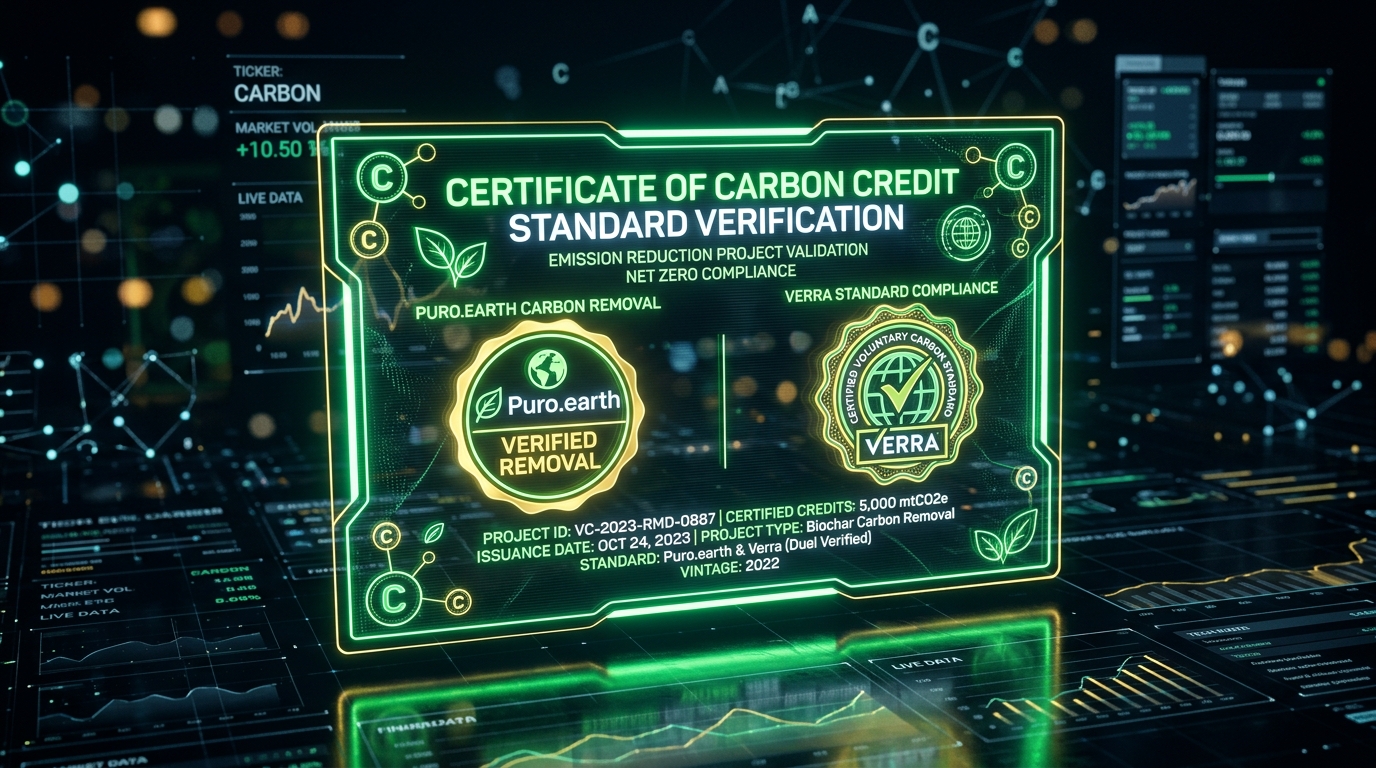
 (Automated Credit Minting: Puro.earth / Verra / Gold Standard)
The Three Layers of the dMRV Stack
- Edge Hardware Layer (IoT Sensors & Process Telemetry): Autonomous IoT sensor nodes deployed on industrial hardware (e.g., biochar pyrolyzers, Direct Air Capture DAC modules, soil gas flux chambers). Hardware units embed Hardware Security Modules (HSM) that cryptographically sign telemetry data packages right at the physical source.
- Cloud Analytics & Processing Layer (Data Fusion & AI): Cloud platforms ingest sensor feeds via secure NB-IoT cellular or LoRaWAN satellite links. Machine learning algorithms cross-reference ground sensor measurements with multi-spectral satellite imagery (Copernicus Sentinel-2, Planet Labs), calculating net carbon mass balance and lifecycle emissions (LCA) in real time.
- Validation & Registry Layer (Smart Contracts): Upon verifying that net sequestered $CO_2$ meets methodology thresholds (e.g., Puro.earth or Verra standard requirements), audited smart contracts automatically trigger carbon credit minting on immutable digital registries, ensuring total sensor-to-certificate auditability.
2. Deploying dMRV in Biochar and Carbon Removal (CDR)
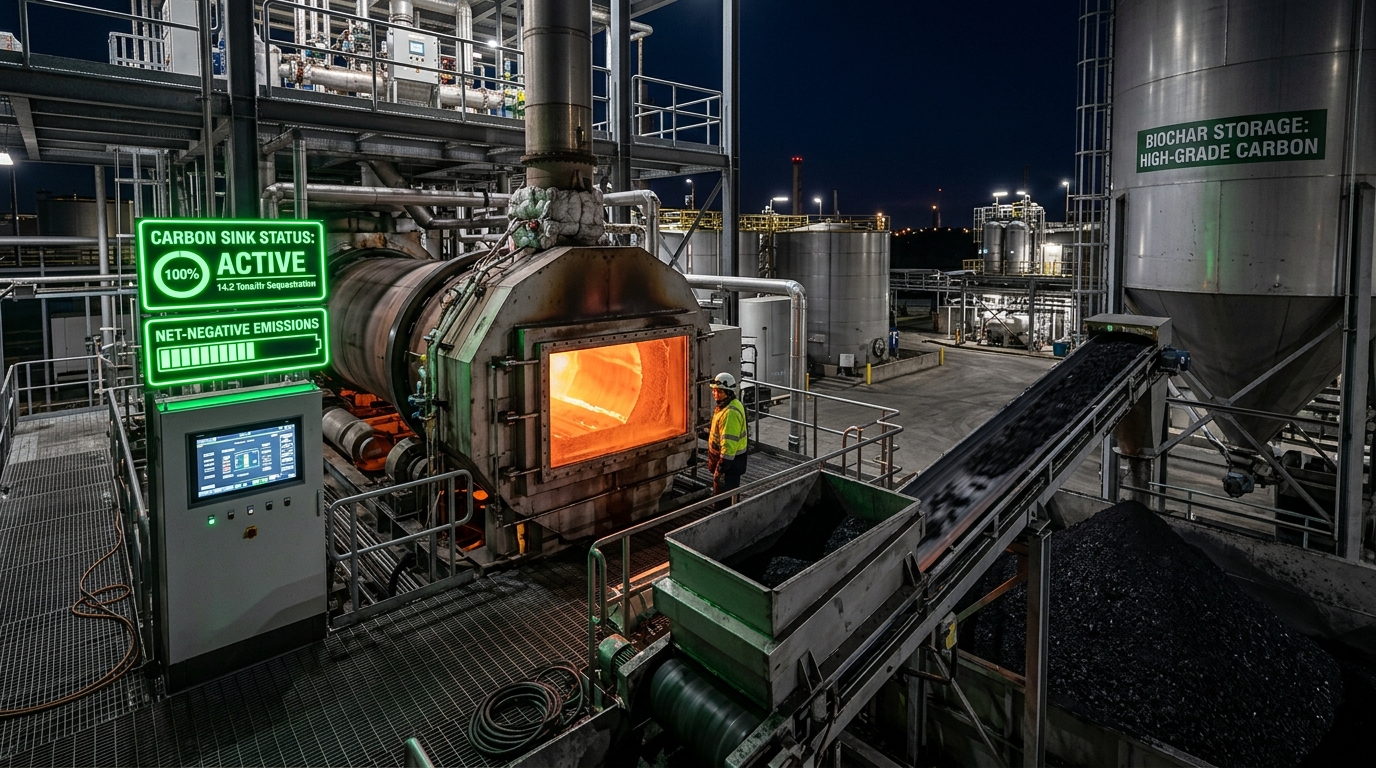
In biochar carbon removal (pyrolyzing biomass waste into stable elemental carbon), dMRV converts distributed industrial operations into transparent, bankable financial assets.
[Biochar Pyrolysis Plant] ──(IoT Sensors: Temp, Press, Gas, Mass)──> [Encrypted HSM Firmware]
                                                                               │
                                                               (NB-IoT / Satellite Upload)
                                                                               │
                                                              [Net Carbon Removal Calculation (dMRV)]
                                                                               │
                                                              [Automated Puro.earth Credit Minting]
Continuous IoT Telemetry on Biochar Pyrolysis Units
To certify a Biochar Carbon Removal Certificate (CORC), dMRV systems continuously track four critical operational parameters:
- Pyrolysis Reactor Temperature ($>500^\circ\text{C}$): Sustained peak temperature guarantees complete biomass carbonization and aromatic ring stability ($H/C_{org} \text{ molar ratio} < 0.4$), essential to verify 1,000+ year soil permanence.
- Real-Time Mass Balance In/Out: Industrial IoT load cells weigh incoming dry biomass feedstocks and output biochar tonnage in real time.
- Process Emissions ($CH_4$ & $N_2O$): NDIR optical gas sensors monitor thermal oxidizer stacks, verifying complete combustion of pyrolytic off-gases and zero methane slip.
- GPS & Soil Application Tracking: Biochar super-sacks or transport trucks carry IoT tags / digital seals, verifying delivery and soil application to eliminate double-counting risks.
3. Sensor Fusion and Satellite Remote Sensing Integration
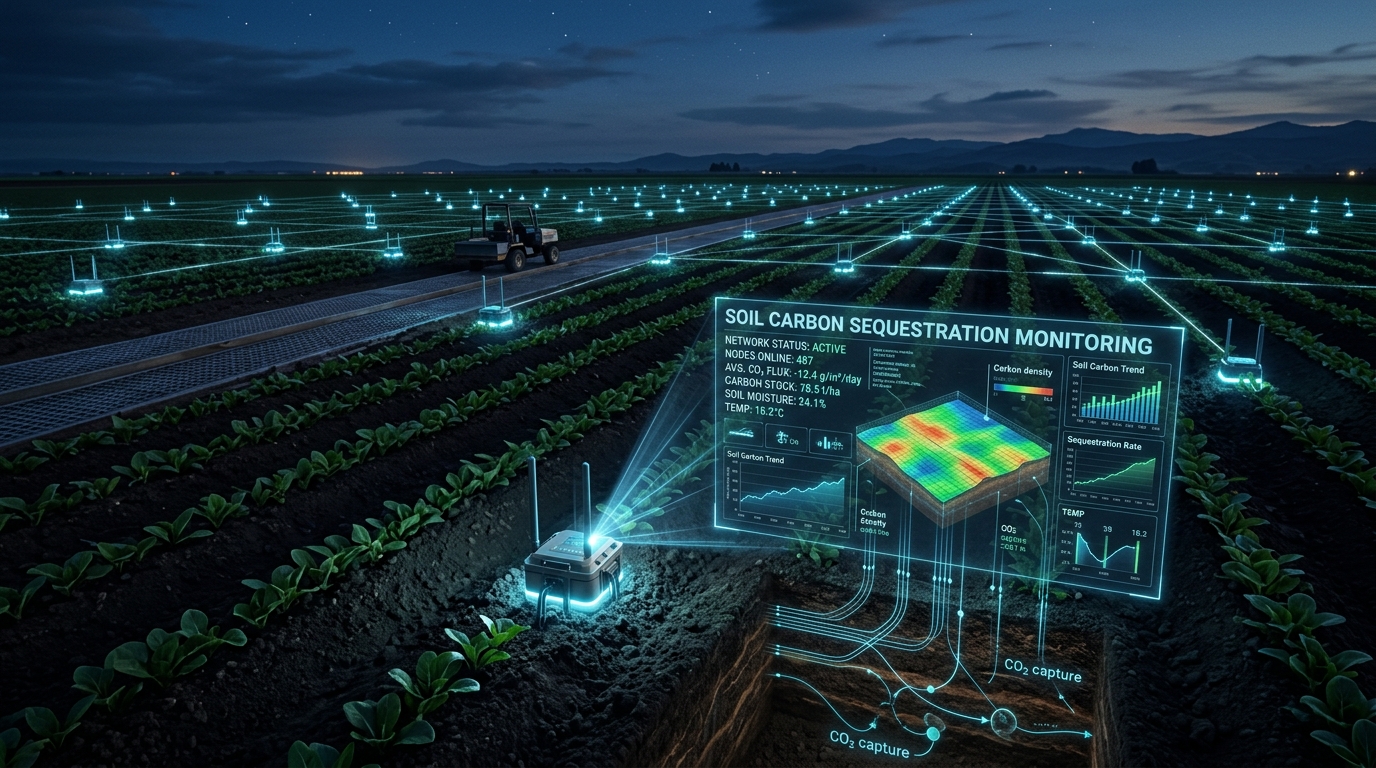
For large-scale nature-based carbon projects—such as regenerative agriculture, soil carbon sequestration, and afforestation—combining ground IoT sensors with satellite remote sensing (Sensor Fusion) sets the gold standard.
- Ground-Truth IoT Nodes: In-situ soil sensors measure bulk density, moisture, electrical conductivity, and soil $CO_2$ flux continuously across depth profiles.
- Spectral Satellite Imagery: Satellites calculate vegetation indices (NDVI, EVI) and canopy biomass dynamics over time.
- AI Model Calibration: Ground IoT data acts as continuous ground truth to train machine learning models estimating soil carbon accumulation over broad acreage, reducing statistical uncertainty below $3%$.
4. Technical and Financial Matrix: Manual MRV vs. IoT-Powered dMRV
| Parameter / Feature | Traditional Manual MRV | IoT & Blockchain dMRV Architecture |
|---|---|---|
| Verification Frequency | Annual or Biennial (Spot audits) | Continuous Real-Time (Edge telemetry) |
| Credit Issuance Time | 12 – 18 Months post-event | < 24 Hours (Automated via Smart Contract) |
| Auditing Cost (% of value) | 20% – 35% of carbon credit value | < 3% – 5% of carbon credit value |
| Measurement Uncertainty | High ($\pm 25% - 40%$) | Very Low ($<\pm 3%$) |
| Fraud & Double-Counting Risk | Medium-High | Zero (Cryptographic HSM & Ledger) |
| Data Transparency | Static PDF Audit Reports | Live Public API & Immutable Ledger |
5. Investment Outlook and Mantohn SA Strategy
From an asset management and venture capital perspective, dMRV technology represents the indispensable infrastructure required to institutionalize carbon markets.
Key Investment Value Drivers:
- Green Premium on dMRV Credits: Carbon removal credits certified via transparent dMRV platforms (e.g., Puro.earth CORCs) command a 50–100% price premium over manual offset credits (€120–€150/ton for biochar dMRV vs. €20–€30/ton for legacy manual forestry credits).
- SaaS and Hardware Opportunities: High growth potential for B2B dMRV Software-as-a-Service platforms and rugged industrial edge IoT hardware providers.
- EU Regulatory Alignment (CRCF): The European Union’s Carbon Removal Certification Framework (CRCF) mandates continuous, digitally verifiable monitoring standards, favoring dMRV-native project developers.
Mantohn SA actively backs and deploys dMRV technology across its biochar, pyrolysis, and waste-to-energy industrial asset portfolio.