When Richard Feynman delivered his famous 1959 lecture “There’s Plenty of Room at the Bottom”, speculating on building molecular-scale machines capable of treating the human body from within, the scientific community treated the idea as fascinating theoretical speculation. Today, over six decades later, medical nanorobotics has crossed the threshold of academic research labs to emerge as one of the 21st century’s highest-impact Deep-Tech sectors across clinical and economic domains.
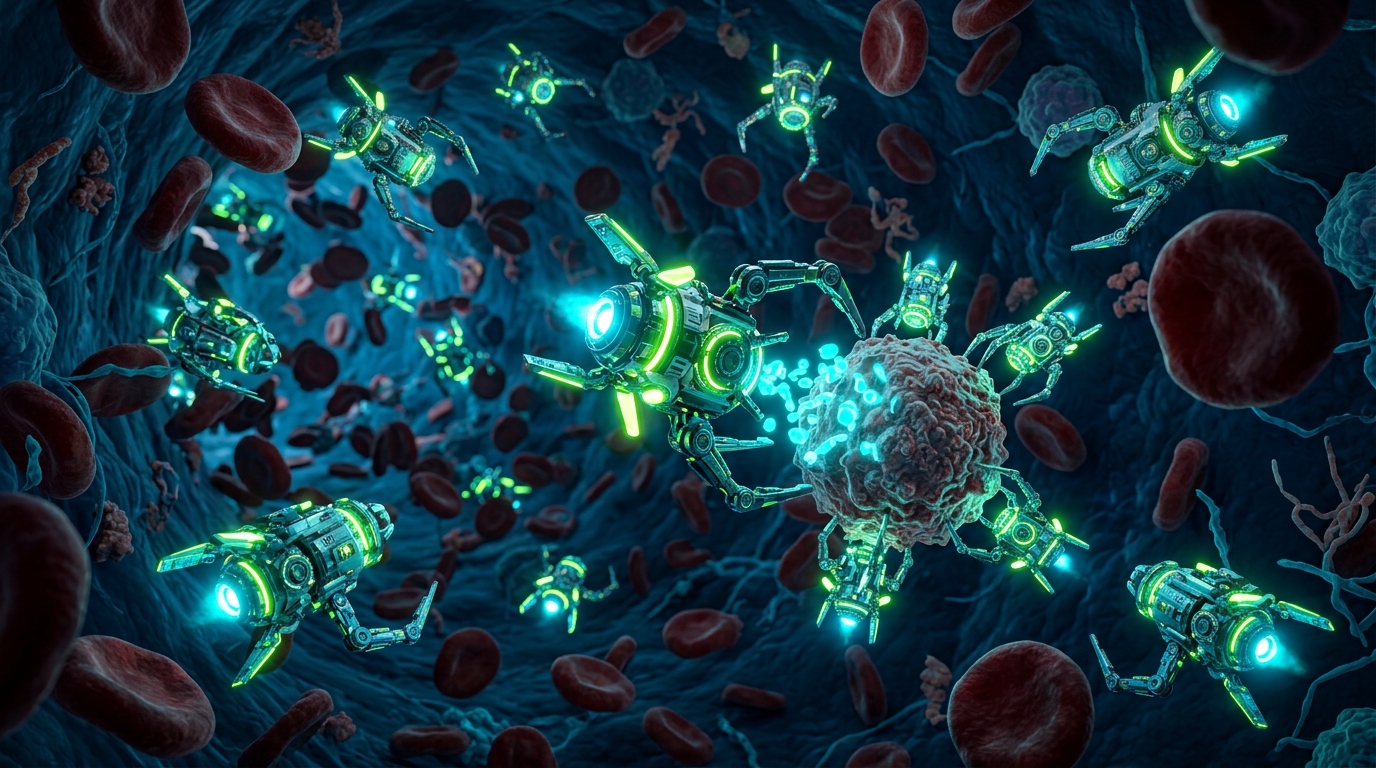
The convergence of materials engineering, molecular biology, electromagnetic field physics, and applied artificial intelligence is redefining medical intervention. We are moving beyond systemic treatments where active pharmaceutical ingredients disperse indiscriminately throughout the body — often causing severe side effects — toward intelligent micro- and nanometric agents capable of autonomously navigating vascular networks, identifying pathological cellular markers, and executing targeted micro-therapeutic operations with metric precision.
1. Propulsion Physics and Nanometric Architectures
Operating at nanometric (1 nm = $10^{-9}$ m) and micrometric scales requires navigating physical laws vastly different from the macroscopic world. At these dimensions, inertial forces become negligible compared to viscous fluid forces in blood, described in bioperfusion physics by extremely low Reynolds Numbers ($Re \ll 1$). To move through the circulatory system, a nanorobot cannot rely on traditional physical propellers; it must employ non-reciprocal propulsion mechanisms.
       [3D EXTERNAL MAGNETIC FIELD]
                    │
                    ▼
┌─────────────────────────────────────────┐
│ Ferromagnetic Micro-Helices / Nanowires │ ➔ Translational Helical Motion
└─────────────────────────────────────────┘   in Blood Vessels
                    │
                    ▼
┌─────────────────────────────────────────┐
│ Tumor Receptor Targeting                │ ➔ Controlled Drug Release (pH/IR)
└─────────────────────────────────────────┘
Leading Navigation Architectures:
-
Externally Driven Magnetic Nanorobots: Composed of synthetic helical structures or ferromagnetic spirals coated in biopolymers (e.g., PEG or PDMS). External Helmholtz coils or permanent magnets generate low-frequency rotating magnetic fields, inducing corkscrew motion that drives nanorobots through viscous blood with high precision.
-
Bio-Hybrid Systems: Leverage natural single-cell organisms — such as magnetotactic bacteria (Magnetospirillum magneticum) or sperm cells — coupled to artificial micro-containers housing therapeutic payloads. Magnetotactic bacteria naturally synthesize chains of magnetosomes (magnetite nanocrystals) that act as an orientable biological compass, combining autonomous flagellar propulsion with external magnetic guidance.
-
DNA Origami Structures & Metal-Organic Frameworks (MOF): Engineered by folding synthetic DNA strands or assembling porous organometallic lattices. These 3D nanostructures function as “smart containers” locked by molecular aptamers: when aptamers bind specific receptors overexpressed on tumor cells (e.g., nucleolin or HER2), the structure undergoes conformational changes, instantly releasing the chemotherapeutic payload.
2. Clinical Applications: From Targeted Delivery to Thrombectomy
Nanometric precision is transforming therapeutic protocols across three primary clinical fields:
A. High-Precision Oncology (Targeted Drug Delivery)
In traditional chemotherapy, only a minuscule fraction (often under 1%) of active agents reaches tumor sites, while systemic exposure damages healthy tissues. Nanorobots enable radical targeted delivery:
- Crossing Physiological Barriers: Penetrating the blood-brain barrier (BBB) to treat glioblastomas and brain tumors previously inaccessible to conventional drugs.
- Triggered Release: Drug release can be triggered locally via magnetic hyperthermia (high-frequency heating of iron oxide nanoparticles) or environmental shifts (acidic pH or elevated tumor enzyme concentrations).
B. Vascular Micro-Surgery and Stroke Treatment
- Nanometric Mechanical Thrombectomy: Magnetic micro-robots can be navigated with sub-millimeter precision into obstructed cerebral or coronary arteries to mechanically disrupt fibrin clots or deliver concentrated tissue plasminogen activators (tPA), reducing systemic hemorrhage risks.
| Clinical Parameter | Traditional Chemotherapy | Nanorobot-Guided Therapy |
|---|---|---|
| Drug Localization | Systemic (whole body) | Focal (strictly localized to tumor site) |
| Therapeutic Efficacy at Target Site | 0.5% – 2% of injected dose | > 80% of targeted dose |
| Systemic Toxicity & Side Effects | High (alopecia, neutropenia, fatigue) | Negligible or absent |
| Blood-Brain Barrier Penetration | Extremely difficult / Impossible | Achievable via active propulsion |
3. In-Vivo Imaging & Biological Safety (Clearance and Biocompatibility)
Broad clinical adoption of medical nanorobotics required resolving two strategic bottlenecks: real-time in-vivo tracking and post-treatment clearance.
Real-Time In-Vivo Tracking
Locating nanorobot populations within vascular networks demands diagnostic imaging with high spatiotemporal resolution:
- Magnetic Particle Imaging (MPI): Leverages non-linear magnetic responses of superparamagnetic iron oxide nanoparticles (SPIONs) to reconstruct high-resolution 3D images without ionizing radiation.
- Photoacoustic Imaging (PAI): Combines short-pulse laser excitation with acoustic ultrasound detection of thermoelastic expansion in nanorobots, providing deep high-contrast structural mapping.
Biodegradability & Clearance
Nanorobots must not accumulate in the liver, spleen, or kidneys to cause long-term toxicity. Industrial R&D prioritizes bio-resorbable materials:
- Utilizing biodegradable polymers like PLA (polylactic acid) and PLGA, which degrade into harmless metabolic byproducts (water and carbon dioxide).
- Designing porous silicon matrices that spontaneously dissolve into silicic acid, excreted renally within 48–72 hours.
4. Market Analysis and Investment Strategy for Mantohn SA
The nanomedicine and active nanorobotics market is expanding at an estimated Compound Annual Growth Rate (CAGR) exceeding 18% over the 2025–2035 decade, driven by demographic aging and demands for shorter hospital stays.
                    ┌──────────────────────────────────────────────┐
                    │ CLINICAL REVOLUTION & PERSONALIZED MEDICINE  │
                    └──────────────────────┬───────────────────────┘
                                           │
                                           ▼
┌──────────────────────────┐    ┌──────────────────────────┐    ┌──────────────────────────┐
│ REDUCED HOSPITAL COSTS   │ ➔  │ PATENT MONETIZATION      │ ➔  │ M&A EXITS PHARMA/MEDTECH │
│ Out-patient procedures   │    │ Platform Tech & IP Shield│    │ Acquisitions by Big Tech │
└──────────────────────────┘    └──────────────────────────┘    └──────────────────────────┘
Strategic Capital Allocation Vectors:
-
3D Magnetic Control Hardware Platforms: The major bottleneck lies not only in nanorobot chemical synthesis, but in operating-room magnetic actuation hardware. Mantohn SA identifies high value in scale-ups developing magnetic actuation platforms that integrate with existing hospital fluoroscopy and MRI systems.
-
Theranostic Platform Technologies: Companies engineering “theranostic” nanovectors capable of integrating diagnostic contrast agents and personalized therapeutic delivery within a single agent.
-
Intellectual Property & Regulatory Hardening: Rigorous evaluation of patent portfolios and FDA regulatory approval pathways (Fast Track designation for combination bio-mechanical medical devices) alongside EMA frameworks.
Medical nanorobotics represents the pinnacle of technological convergence. By shifting medicine from a predominantly chemical discipline toward molecular and mechanical precision engineering, it unlocks high-value investment horizons redefining human health standards.