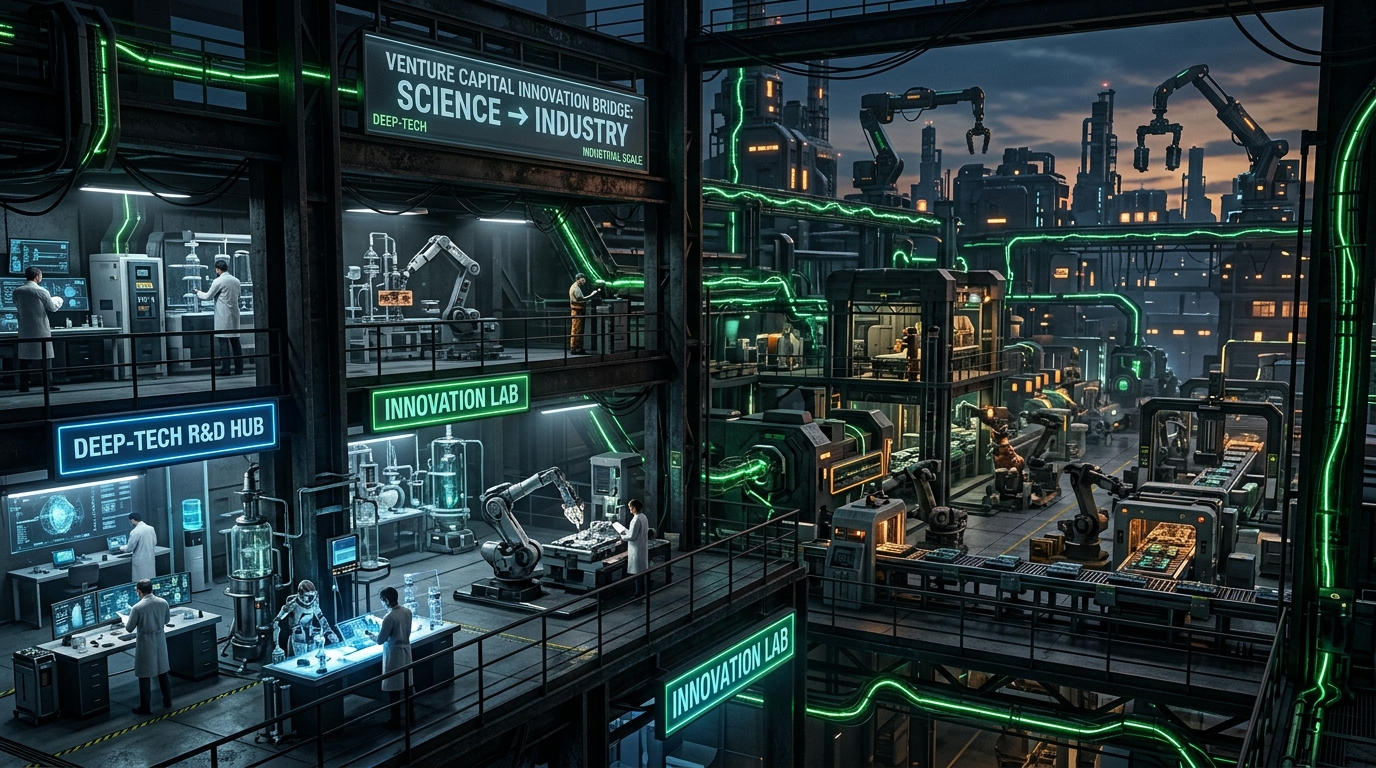
The Deep-Tech sector represents the vibrant core of industrial innovation and the transition toward sustainable manufacturing models. Unlike startups focused on consumer software or application-level SaaS, Deep-Tech ventures stem from foundational scientific breakthroughs, applied physics discoveries, advanced biotechnology, novel materials chemistry, and hard-tech energy and automation architectures.
However, moving a discovery from an academic laboratory to commercial-scale industrial manufacturing is fraught with structural hurdles. This critical phase is universally known as the “Valley of Death”: a financial and operational chasm separating laboratory scientific proof from a robust, scalable commercial product.
In this analysis, we examine the causes of this phenomenon, the Technology Readiness Levels (TRL) scale, de-risking strategies, and the capital architecture required to transform high-potential research into high-impact industrial assets.
1. Anatomy of the Deep-Tech Valley of Death
In a deep-tech startup’s lifecycle, failure rates peak between initial proof of concept and pilot plant commissioning. While software ecosystems enjoy near-zero marginal costs and rapid development cycles, physical industrial hardware must confront the unyielding laws of physics and capital intensity.
[ TRL 1 - 3 ]           [ TRL 4 - 6 ]             [ TRL 7 - 9 ]
Basic Research      ➔   Valley of Death      ➔    Industrial Scaling
(Grants/Academia)       (Patient Capital)         (Growth VC / Debt / M&A)
Three Dimensions of Deep-Tech Fragility:
- High CapEx Intensity: Developing industrial prototypes, chemical reactors, or semiconductor devices demands massive upfront physical investments long before generating initial revenue.
- Extended Development Timelines: The journey from patent filing to market deployment typically spans 5 to 10 years, compared to 6 to 18 months for software applications.
- Dual Technological and Market Uncertainty: The challenge is not merely proving Product-Market Fit, but first demonstrating Technology-Scale Fit — verifying the technology operates reliably and economically under continuous industrial conditions.
2. TRL Mapping: Where Do Technologies Fail?
The TRL scale developed by NASA and adopted across the European Union’s Horizon Europe program provides a framework for gauging technological maturity:
| TRL Level | Process Phase | Primary Associated Risk | Typical Funding Source |
|---|---|---|---|
| TRL 1 – 3 | Basic research & lab proof-of-concept | Scientific Risk | Public grants, university funds |
| TRL 4 – 5 | Laboratory/simulated validation | Tech Transfer Risk | Seed Deep-Tech Funds, Proof-of-Concept |
| TRL 6 – 7 | Industrial prototype & pilot plant | Scalability Risk (Valley of Death) | Specialized VC, CVC, ESG Grants |
| TRL 8 – 9 | Completed system qualified commercially | Execution & Market Risk | Private Equity, Project Finance, Debt |
Structural failures historically cluster around TRL 5–7. At this juncture, public academic research grants taper off, while traditional Venture Capital firms view investments as premature and overly risky relative to standard 5-to-7-year fund exit horizons.
3. De-Risking Strategies: From Lab to Factory Floor
Surviving the Valley of Death requires more than simple capital injection. Founders must execute an integrated strategic framework across three operational pillars:
A. Modular Design and Phased Pilot Plants
Attempting an immediate jump from bench scale (grams/liters) to gigawatt/ton scale is a recipe for engineering failure. Constructing modular pilot plants enables teams to:
- Test material tolerances under real-world operational stresses.
- Fine-tune energy efficiency and emission profiles.
- Supply physical off-take samples to early industrial clients for rigorous qualification loops.
B. Intellectual Property Protection & Trade Secrets
In Deep-Tech, Intellectual Property is the foundational corporate collateral. University spin-offs must negotiate clear, transparent, and exclusive licensing terms with host institutions, while defending not only core product patents, but also trade secrets surrounding manufacturing processes and assembly techniques.
C. Off-take Agreements and Early Corporate Partnerships
Engaging major industrial incumbents (Corporate Incumbents) at TRL 5–6 via conditional off-take agreements (purchase commitments linked to achieving specific performance benchmarks) sharply mitigates commercial risk for financial investors.
4. Financial Architecture: The Role of Patient Capital
Bridging the Valley of Death requires a blended, synergistic capital structure moving beyond pure short-term equity.
       [ Public Grants / Non-Dilutive Funding ]
                          +
       [ Specialized Patient Venture Capital ]
                          +
   [ Corporate Venture Capital (CVC) & Industrial Debt ]
                          ↓
      = [ Blended High-Impact Capital Structure ]
1. Patient Capital
Investment funds structured around 10-to-12-year horizons (with extensions up to 15 years) capable of supporting ventures through multi-year hardware validation and plant engineering cycles.
2. Public-Private Blended Finance
Integrating state guarantees, European Investment Bank (EIB) financing, non-dilutive grants (such as EIC Accelerator), and private equity lowers the Weighted Average Cost of Capital (WACC) while minimizing early founder dilution.
3. Corporate Venture Capital (CVC)
Corporate venture arms offer value beyond financial capital: providing immediate access to global supply chains, process engineering expertise, and regulatory/certification channels.
5. Embedding ESG Criteria as Valuation Drivers
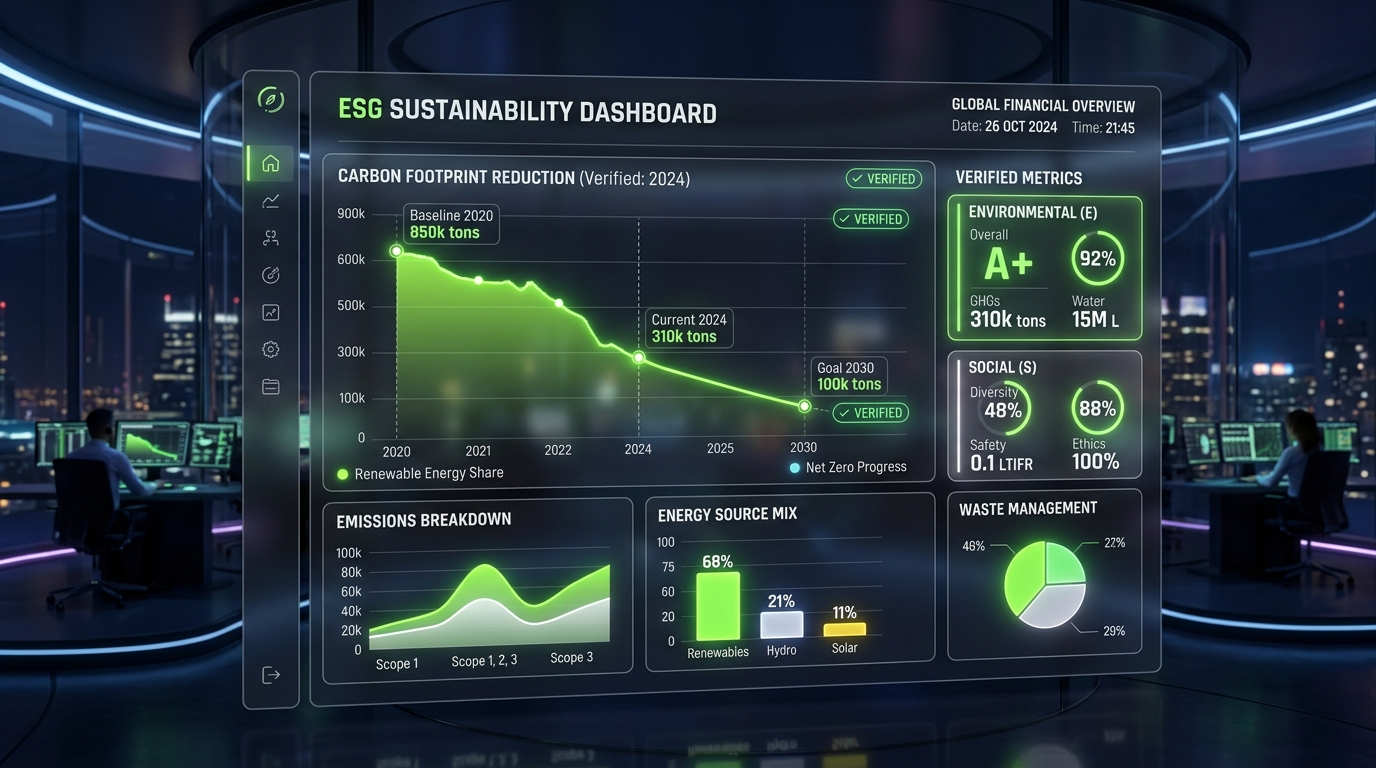
Contemporary industrial Deep-Tech ventures must embed environmental impact measurement from early R&D phases (Sustainability by Design).
Institutional investors apply rigorous due diligence based on:
- Life Cycle Assessment (LCA): Quantifying carbon footprint and resource consumption across manufacturing, operational, and end-of-life phases relative to incumbent solutions.
- EU Taxonomy Compliance: Verifying that technology contributes substantially to decarbonization, circular economy, or pollution prevention without causing significant harm (Do No Significant Harm - DNSH).
Robust ESG impact tracking transforms technology from a functional innovation into an essential solution for enterprise clients undergoing ecological transition.
6. Strategic Conclusions: The Mantohn SA Outlook
Crossing the Deep-Tech Valley of Death is not merely a financial challenge; it is an industrial and geopolitical necessity. The ability to translate scientific discoveries into real manufacturing capability will determine which economic regions lead the 21st-century industrial transition.
Investment holdings like Mantohn SA serve as strategic and operational bridges during this delicate phase: combining patient capital, sustainability analytical rigor, and process engineering expertise to guide breakthrough hardware innovations to full commercial maturity.